
Day 1 · Stakeholder Management Mastery: The Skill That Makes or Breaks Projects
Why Stakeholder Management Is the Most Underrated Skill in Business Analysis
Let me tell you about a project that should not have failed. The scope was clear, the budget was approved, the development team was experienced, and the technology was proven. By every conventional measure of project readiness, this one had everything it needed to succeed.
It failed anyway.
Not because the requirements were wrong. Not because the technical solution did not work. It failed because a senior stakeholder who had been disengaged for four months showed up in the final review and rejected the output. He had not been consulted during the design. His concerns had not been captured. His team would be most affected by the change, and nobody had thought to make him a genuine partner in the process.
The project was shelved. Months of work and a significant budget. All of it was lost to a stakeholder management failure that a more experienced Business Analyst would have seen coming from week one.
I have seen variations of this story more times than I can count. And every time, the post-mortem points at the same root cause: the people side of the project was treated as a secondary concern. Technical delivery took the attention. Stakeholder management was assumed to be taking care of itself. It never takes care of itself.
What Stakeholder Management Actually Is
Here is the definition most BA training programmes give you: stakeholder management is the process of identifying, analysing, and engaging individuals or groups who have an interest in the outcome of a project. That definition is not wrong, but it is incomplete in a way that matters. It describes the mechanics without capturing the purpose.
Stakeholder management, in practice, is the ongoing work of understanding what each person or group needs from a project, what they fear about it, what they are willing to give to it, and what they will do if those needs and fears are not addressed. It is the craft of turning a group of individuals with different interests, different levels of influence, and different relationships with change into a coalition that is pulling in the same direction.
That is not a process. It is a discipline. And like every discipline, it requires genuine skill, consistent attention, and a willingness to prioritise the human dynamics of a project even when the technical demands are loud and urgent.
Why Most Projects Fail Because of People, Not Process
The data on this is consistent and has been for decades. The Standish Group's Chaos Report, which has tracked software project delivery since the 1990s, repeatedly identifies stakeholder-related factors among the top reasons for project failure: lack of user involvement, lack of executive support, unclear business objectives, and changing requirements. All of these are, at their root, stakeholder management failures.
Lack of user involvement means the people who will use the system were not brought into the process early enough or deeply enough. Their needs were assumed rather than elicited. Their feedback was sought too late to influence anything meaningful.
Lack of executive support means the sponsor's commitment was never properly secured, or it was secured at the start and then allowed to erode without anyone noticing or addressing it.
Unclear business objectives mean the people with the authority to define what success looks like were never aligned in the first place. Everybody signed the project charter. Nobody agreed on what it meant.
Changing requirements, in most cases, does not mean the business world has changed. It means stakeholders were not properly engaged during requirements gathering, so what they said they wanted at the start was not actually what they needed. When they saw the output, they changed it. Not because they were difficult, but because nobody had asked them the right questions in the first place.
These are not process failures. They are relationship and communication failures. And they are almost entirely preventable with the right stakeholder management practice.
The Cost of Getting It Wrong
The direct cost of stakeholder management failure is easy to quantify: project overruns, rework, delayed delivery, wasted budget. These are real and significant. A project that requires three additional months of rework because a key stakeholder group was not consulted during design is paying an avoidable premium that can be traced directly to a stakeholder management gap.
But the indirect costs are often larger. Damaged relationships between the delivery team and the business, loss of confidence in the BA function, stakeholder resistance to future projects because the last one left a bad experience. In some organisations, a single high-profile project failure caused by poor stakeholder management creates a credibility problem that takes years to recover from.
For the individual BA, the career cost is equally significant. A Business Analyst who consistently struggles with stakeholder relationships will plateau. They may be technically excellent, their requirements documentation may be meticulous, but if they cannot hold the room, navigate resistance, build trust with a difficult sponsor, or bring a fragmented stakeholder community to alignment, they will not be given the projects that matter. Senior delivery programmes go to BAs who can manage the people, not just the process.
What Stakeholder Management Mastery Actually Looks Like
There is a meaningful difference between a BA who manages stakeholders and a BA who has mastered stakeholder engagement. The difference shows up not in the tools they use or the frameworks they know, but in how they think about the people on their projects.
The BA who manages stakeholders thinks about stakeholder engagement as a task to complete. Identify the stakeholders, fill in the power-interest grid, send the update emails and run the workshop. In other words, just tick the box.
The BA who has mastered stakeholder engagement thinks about it as a continuous, relational practice. They are always reading the room. They notice when a stakeholder who was engaged last week has gone quiet this week. They understand that a sponsor asking pointed questions in a meeting is telling them something about their level of comfort with the project direction. They know that resistance to a requirement is often not about the requirement at all but about something deeper: a fear, a political concern, a historical grievance that needs to be surfaced and addressed.
Mastery means being genuinely interested in the people, not just the process. It means building relationships that exist outside of meeting rooms and formal reviews. It means being the person that stakeholders call when they have a concern before it becomes a problem, because they trust you to handle it with discretion and competence.
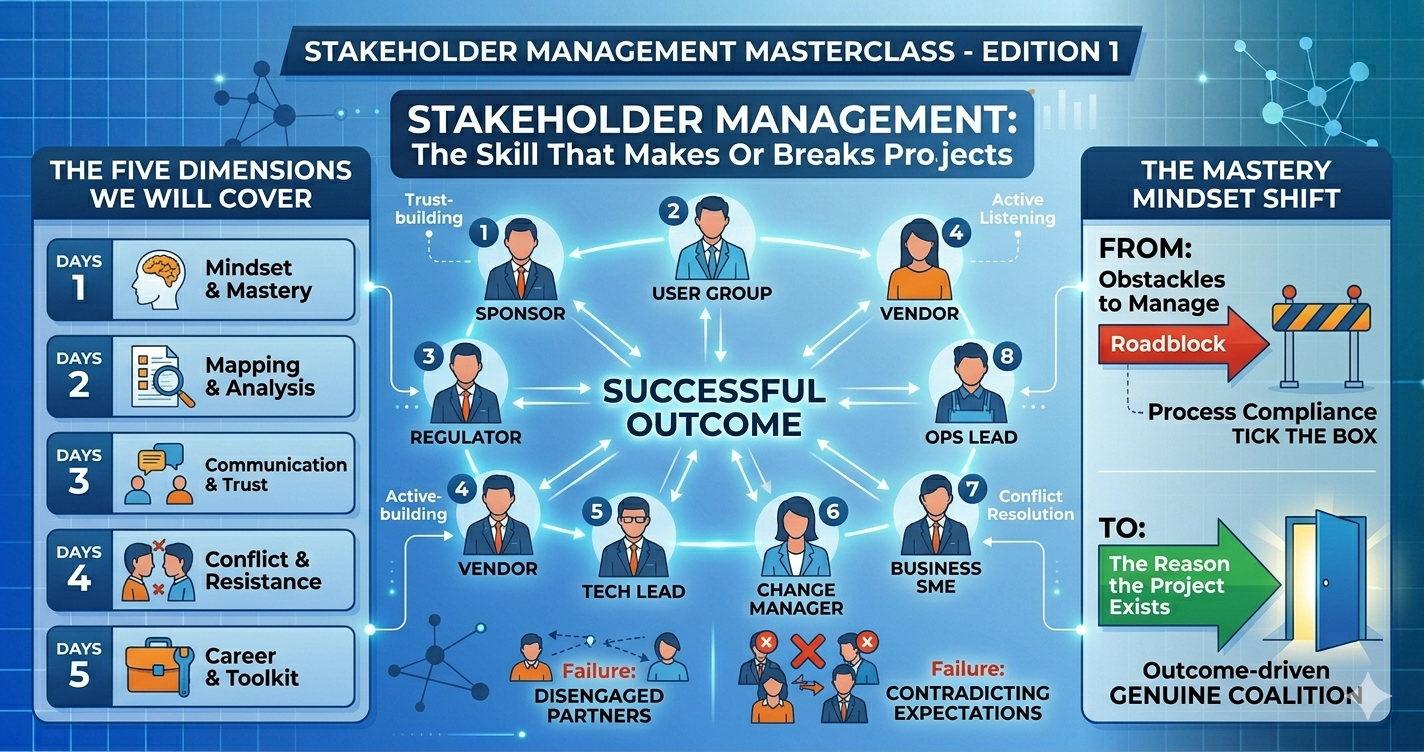
The Five Dimensions of Stakeholder Management We Will Cover This Week
Over the next five days, we are going to build a complete stakeholder management framework that you can apply to your next project, adapt to your industry, and use to demonstrate mastery in any career conversation.
Day 1 (today): Why stakeholder management makes or breaks projects, what mastery looks like, and the mindset shift that separates good BAs from great ones.
Day 2: Mapping and analysing your stakeholders using the Power-Interest Grid, RACI, and the Salience Model, building a living stakeholder register, and the mistakes BAs consistently make with each tool.
Day 3: Communication strategies and trust-building. How to tailor your approach to different stakeholder types, manage expectations before they become problems, and what a practical stakeholder communication plan actually looks like.
Day 4: Difficult stakeholders, conflict and resistance. The types of difficult behaviour, what drives them, the BA toolkit for managing each, and when to absorb versus when to escalate.
Day 5: Career application, interview preparation, and a free downloadable Stakeholder Management Toolkit to take away and use immediately.
The Mindset Shift That Changes Everything
Before we go deeper this week, there is one mindset shift I want you to carry into everything that follows. Stakeholders are not obstacles to manage. They are the reason the project exists. Every project is funded by someone, used by someone, and affected by someone. The stakeholders are not background characters in the delivery story. They are the main characters. The technology, the process, the documentation, the methodology, all of it exists to serve them.
When you hold that view, stakeholder engagement stops being a task on your project plan and starts being the central thread of your work. You stop asking 'have I done the stakeholder update?' and start asking 'do the people who need to be informed, aligned, and supported actually feel informed, aligned, and supported?'
Those are different questions. The first one is about process compliance. The second one is about outcomes. And the Business Analysts who consistently deliver outstanding results are the ones asking the second question. That is what this week is about. Let us get into it.
Go out and be successful.
Oluwatosin Ogunkoya
Tomorrow: Mapping Your Stakeholders. The analytical tools every BA must know, how to build a stakeholder register that actually works, and the mistakes that most BAs make with each framework.