
Day 2 · Stakeholder Management Mastery: The Skill That Makes or Breaks Projects
Mapping Your Stakeholders: The Analytical Tools Every BA Must Know
Early in my BA career, I made a mistake that many analysts make without realising it.
I identified my stakeholders, built a neat grid, categorised everyone, and then filed it away. I treated stakeholder mapping as a project initiation activity, something you did at the start and returned to if something went wrong. Halfway through a significant programme, a stakeholder I had categorised as low power and low interest turned out to be the single biggest barrier to go-live. His role had changed. His team would be directly affected by the new process. And because I had not kept my stakeholder map current, I did not see it coming until it was almost too late.
Stakeholder mapping is not a project initiation task. It is a living analytical practice. And the tools only work if you use them properly and keep them up to date. Today, we cover the three analytical frameworks every BA must have a genuine command of, what each one is actually for, and the mistakes that make them less useful than they should be.
Tool 1: The Power-Interest Grid
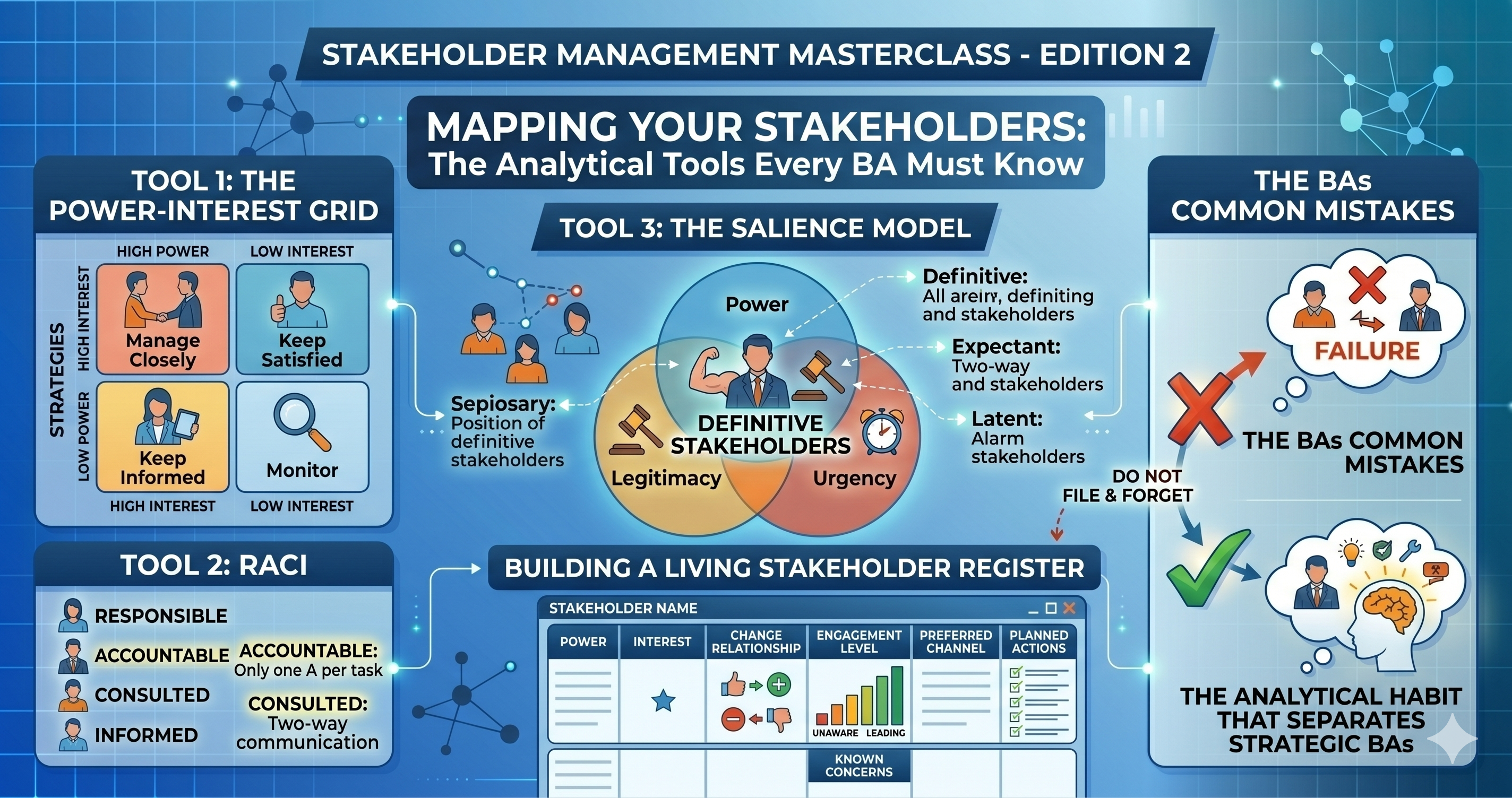
The Power-Interest Grid is the most widely known stakeholder analysis tool in project management and business analysis. It maps stakeholders across two dimensions: the level of power or influence they have over the project, and the level of interest they have in its outcome. The result is four quadrants, each with a different engagement strategy.
High power, high interest: these are your key stakeholders. Manage them closely. They have both the authority to significantly affect your project and a personal stake in the outcome. Your project sponsor typically sits here. So do senior business owners and any regulatory bodies with direct oversight of your delivery area. These stakeholders need regular, substantive engagement. Not update emails, but genuine dialogue.
High power, low interest: keep these stakeholders satisfied. They have the ability to influence or derail your project, but are not actively focused on it. Senior executives outside your immediate programme often sit here. Your job is to ensure they remain comfortable with the project direction without demanding too much of their time. Concise, high-quality communication that respects their bandwidth is the approach. If you lose their confidence, they will disengage. If they disengage, they become a risk.
Low power, high interest: keep these stakeholders informed. They care deeply about the outcome but have limited ability to shape it directly. End users, customer-facing teams, and junior members of affected departments often sit here. These stakeholders are often underserved in project communication, which is a mistake. They are the people who will actually use what you build. Their feedback during design and testing is invaluable, and their advocacy at go-live can determine adoption rates. Involve them meaningfully. They will repay the investment.
Low power, low interest: monitor these stakeholders. They require the least active engagement, but that does not mean they are irrelevant. Circumstances change. A stakeholder in this quadrant today may move into a more influential position tomorrow. Keep them on your radar and communicate with them periodically so they do not feel excluded from a project that may eventually affect them.
The most important thing to understand about the Power-Interest Grid is that it is a snapshot, not a photograph. Stakeholder positions change throughout the project lifecycle as roles evolve, political dynamics shift, and the project's impact becomes clearer. A grid you built in week one needs to be reviewed at every major milestone. If you are not revisiting it regularly, you are navigating with an outdated map.
The Three Mistakes BAs Make With the Power-Interest Grid
- Mapping only formal authority and missing informal influence: Power in organisations does not always follow the organisational chart. The senior partner who golfs with the CEO every Friday has influence that does not appear in any reporting structure. The long-serving subject matter expert who every new executive consults has informal power that exceeds their formal grade. When you only map the hierarchy, you miss the influence network, and the influence network often determines what actually happens.
- Building the grid once and never updating it: A stakeholder map that is four months old on a six-month project is not a stakeholder map. It is a historical document. Organisational roles change, programme stakes shift, and people's relationship to change evolves as they understand its implications better. Review your grid at every project milestone as a minimum, and more frequently on fast-moving programmes.
- Using the grid to categorise people rather than to guide relationships: The point of the grid is not to file your stakeholders into boxes. It is to think clearly about what each person needs from you and what you need from them. If you have filled in the grid but you cannot describe your engagement strategy for each high-power stakeholder in a sentence, the grid has become bureaucracy rather than analysis.
Tool 2: RACI
RACI stands for Responsible, Accountable, Consulted, and Informed. It is a decision rights and communication framework that defines how each stakeholder or stakeholder group relates to each task, decision, or deliverable in your project.
Responsible is the person or people who do the work. They execute the task. There can be multiple people who are responsible for a single task if it requires collaboration.
Accountable is the single person who owns the outcome. There can only ever be one person accountable for any given task or decision. If two people are accountable, nobody is accountable. This is not a preference. It is a rule. When you see RACI matrices with multiple A's against a single item, you are looking at an organisation that is about to discover why unclear accountability is so expensive.
Consulted are the people whose input is required before a decision is made or a deliverable is completed. These stakeholders have a two-way communication relationship with the project: they give input, and they expect that input to be considered. Consulting someone and then ignoring their input is worse than not consulting them at all. It damages trust and creates resistance.
Informed are the people who need to be kept up to date with progress or decisions. Their communication is one-way: they receive information but are not expected to provide input. Treating an Informed stakeholder as consulted wastes their time and creates unrealistic expectations. Treating a Consulted stakeholder as merely informed creates resentment when they discover their input was never sought.
The practical value of RACI is not the matrix itself. It is the conversations the matrix forces you to have. When you sit down with your project team to complete a RACI matrix, and you cannot agree on who is Accountable for a critical decision, you have just identified a governance gap that will cause a problem later. Better to surface it now, in a workshop, than to discover it in a steering committee when two executives think they both own the same decision.
Tool 3: The Salience Model
The Salience Model, developed by Mitchell, Agle and Wood, is a more sophisticated stakeholder analysis framework that most BA training programmes mention briefly and do not teach deeply enough.
It categorises stakeholders across three dimensions: power (the ability to influence the project), legitimacy (whether their claim on the project is appropriate and warranted), and urgency (how time-sensitive their concern is and how strongly they are pressing their claim).
Where the Power-Interest Grid gives you a two-dimensional view, the Salience Model gives you a three-dimensional one. Stakeholders with all three attributes, power, legitimacy, and urgency, are Definitive stakeholders. They demand immediate, substantive attention. Stakeholders with two attributes are Expectant: they are not as immediately pressing, but cannot be ignored. Stakeholders with only one attribute are Latent: they are the ones most often underestimated.
The Salience Model is particularly useful in two situations. The first is when you have a complex stakeholder landscape with many parties, and you need a principled way of prioritising your engagement effort. The second is when a stakeholder who does not appear powerful is behaving with unusual urgency, which is a signal that you may have misassessed their legitimacy, their influence, or both.
In practice, most BAs use the Power-Interest Grid for day-to-day stakeholder management and reach for the Salience Model when the landscape is unusually complex or when the Power-Interest Grid is not giving them enough analytical depth to understand a difficult stakeholder dynamic.
Building a Living Stakeholder Register
All three tools feed into what should be the central document of your stakeholder management practice: the stakeholder register. It's not a static spreadsheet filed at project initiation, but a living record that is updated throughout the project lifecycle. A useful stakeholder register captures more than contact information and the power-interest quadrant. It should include the stakeholder's relationship to the change (what they stand to gain, what they stand to lose), their current engagement level (unaware, resistant, neutral, supportive, or leading), their preferred communication channel and frequency, any known concerns or sensitivities, and your planned engagement actions for the next two weeks.
That last element is the one most registers miss. A stakeholder register without a forward-looking action list is a description, not a plan. The register should tell you what you need to do next for each key stakeholder, not just who they are.
Review your register at every project milestone. Ask yourself whether the engagement levels have changed, whether any new stakeholders have emerged, and whether your planned actions from the last review were actually carried out. A register that nobody updates is not a stakeholder management tool. It is a document that creates false confidence.
The Analytical Habit That Separates Strategic BAs
The BAs who are consistently trusted with the most complex and politically sensitive programmes are the ones who have developed a genuine analytical habit around their stakeholders. They think about their stakeholder landscape regularly, not just at project initiation. They ask the right questions: who has something to lose from this project? Who has not been heard yet? Who is quiet when they should be engaged? Whose position has shifted since I last checked?
The tools in today's article are not ends in themselves. They are thinking frameworks. The goal is not a completed grid. The goal is a clear, current understanding of your stakeholder landscape and a confident plan for navigating it. That understanding, held in your head and maintained in your register, is what makes the difference between a BA who is managing events and a BA who is shaping outcomes.
Go out and be successful.
Oluwatosin Ogunkoya
Tomorrow: Communication and Trust. How the best BAs build relationships that hold under pressure, what a stakeholder communication plan actually looks like in practice, and the strategies that turn difficult relationships into productive ones.