
Day 5 · Stakeholder Management Mastery: The Skill That Makes or Breaks Projects
Stakeholder Mastery in Practice: Career Application, Interview Prep and Your Free Toolkit
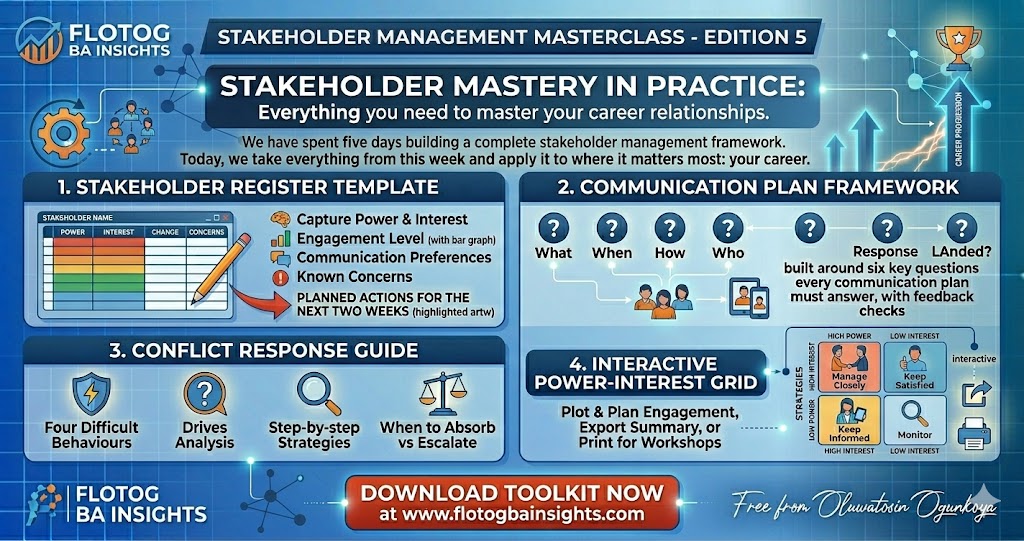
We have spent five days building a complete stakeholder management framework.
Day 1 established the foundation: why stakeholder management is the skill that determines project outcomes more than any other, what mastery actually looks like, and the mindset shift that changes how you approach every project.
Day 2 covered the analytical tools: the Power-Interest Grid, RACI, and the Salience Model, how to build a living stakeholder register, and the mistakes that reduce these frameworks from analytical instruments to administrative exercises.
Day 3 addressed communication and trust: why communication is a strategic discipline, how to tailor your approach to different stakeholder types, and what a real stakeholder communication plan looks like in practice.
Day 4 tackled difficult stakeholders: the four types of difficult behaviour, what drives each one, the response strategies that work, and when to absorb versus when to escalate.
Today, we take everything from this week and apply it to where it matters most: your career.
What Stakeholder Mastery Looks Like at Every BA Level
Stakeholder management competence does not look the same at every stage of a BA career. Understanding what is expected at each level, and being able to demonstrate that you are meeting or exceeding those expectations, is one of the clearest ways to signal career readiness for the next level.
At the Junior BA level, stakeholder mastery is about engagement and awareness. A junior BA who demonstrates stakeholder mastery is one who can identify the key stakeholders on their project, understand who needs to be communicated with and how, and execute the engagement activities they have been asked to carry out reliably and professionally. They do not yet need to be designing stakeholder strategies. They need to show that they understand why stakeholder management matters, that they can execute engagement tasks well, and that they notice when something is not quite right in a stakeholder relationship, even if they are not yet sure what to do about it.
At the mid-level BA, the expectation shifts from execution to ownership. A mid-level BA who demonstrates stakeholder mastery is building and maintaining their own stakeholder analysis, making independent judgements about communication frequency and format, recognising and proactively addressing difficult dynamics before they escalate, and managing expectation gaps without being prompted to do so. They are not just running the stakeholder management process. They are responsible for the quality of the stakeholder relationships on their project.
At the Senior BA level, stakeholder mastery is about influence and strategy. A senior BA is advising project sponsors on stakeholder dynamics, coaching junior team members on engagement approaches, navigating complex political landscapes with confidence, and shaping the stakeholder strategy for programmes that span multiple organisations and competing interest groups. Their stakeholder management is not reactive. It is anticipatory. They can see where stakeholder problems are forming before the project does, and they address them before they become crises.
How to Demonstrate Stakeholder Mastery in Interviews
Stakeholder management is one of the most commonly assessed competencies in BA interviews at every level, and it is one of the areas where candidates most consistently underperform. Not because they lack experience, but because they describe their experience in ways that do not demonstrate the depth of competence the interviewer is looking for.
The most common mistake is describing the process rather than the impact. Saying you used a Power-Interest Grid or maintained a stakeholder register demonstrates awareness of a tool. It does not demonstrate mastery of stakeholder management. What interviewers are actually listening for is evidence of judgement, adaptability, and real-world application. What did you do when the framework did not give you a clean answer? How did you handle a stakeholder whose behaviour was creating a genuine problem for the project? What changed because of how you engaged? Here are six questions you should be able to answer fluently before your next BA interview, with model answers at different levels.
Six Interview Questions With Model Answers
Q1: How do you identify and prioritise stakeholders on a new project? (Junior to Mid)
Model Answer: I start by casting the net wide. I look at who is funding the project, who will use the output, who the change will affect operationally, who has regulatory or compliance oversight, and who has influence over any of those groups. I use the Power-Interest Grid to prioritise engagement effort, making sure I am giving the most time to stakeholders who have both the authority to influence the project and a genuine stake in the outcome. I also spend time understanding informal influence, because organisations have influence networks that do not always follow the reporting structure. The stakeholder register I build at the start of a project is always provisional. I review it at every major milestone because stakeholder positions change as the project progresses, and the reality of the change becomes clearer to people.
Q2: Tell me about a time you had a difficult stakeholder. What did you do? (Mid to Senior)
STAR Model Answer: On a process improvement programme I was leading the analysis for, there was a senior operations manager who had been asked to participate in a series of requirements workshops. She attended the first one and then declined every subsequent invitation. Her team was the primary user group for the new system, and without her input, we were building on assumptions. I arranged a one-to-one with her outside the formal project structure and asked directly whether something about the workshop format or the project itself was making participation difficult. She told me she was concerned that the project was being used to reduce headcount in her department, something nobody had told her team explicitly, and she did not want to be seen to be facilitating that. I took two actions. First, I went back to the sponsor and surfaced this as a risk, because the concern, whether warranted or not, was affecting our ability to capture the right requirements. Second, I arranged a briefing session for her team where the sponsor addressed the headcount question directly. She became one of the most actively engaged stakeholders in the programme. The requirements quality in her area was significantly better for it.
Q3: How do you manage stakeholder expectations when the project is not delivering what was promised? (Mid to Senior)
Model Answer: The most important thing I have learned about managing difficult expectation gaps is that they need to be surfaced early, even when there is no solution yet. Waiting until I have a complete answer before telling a stakeholder about a problem almost always makes the problem worse, because the stakeholder then feels blindsided rather than consulted. My approach is to communicate the issue as soon as I understand it clearly enough to describe it accurately. I bring the relevant facts, my honest assessment of the situation, the options I am exploring, and what I need from the stakeholder to help resolve it. I also look back at how the expectation was set in the first place, because in my experience, most expectation gaps have a root cause earlier in the project that I may have contributed to. Understanding that root cause helps me close the gap and avoid creating the same problem again.
Q4: How do you engage stakeholders who have very limited time? (Any level)
Model Answer: I start by being ruthless about what I actually need from them and how little of their time I genuinely require to get it. A lot of stakeholder communication is longer than it needs to be because the BA has not been disciplined enough about what they are asking for and why. For time-poor stakeholders, I aim to communicate in the format that is easiest for them to consume, typically short and direct written summaries with specific questions or decisions highlighted, rather than meeting requests. When I do need their time in person, I make the objective of the conversation explicit in advance, I prepare thoroughly so I do not waste a minute of their availability, and I send a clear summary of agreed actions within 24 hours. Trust is built in these interactions by consistently respecting the boundary they have set around their time.
Q5: Describe your approach to stakeholder communication planning. (Mid to Senior)
Model Answer: I think about stakeholder communication in terms of what each stakeholder needs to know, when they need to know it, and what channel and format will land most effectively with them. I build a communication plan that is tailored to the project's key stakeholder groups rather than applying a generic template. The plan answers six questions for each group: what information do they need, when do they need it, who delivers it, in what format, what action or response do we need from them, and how will we know the communication has been effective. That last question is one most plans do not address, but it is critical. If I am not checking whether communication is landing and creating the intended response, I am broadcasting rather than communicating. I review the plan regularly and adjust it based on what is actually working, because what works in month one may not work in month four as stakeholder relationships evolve.
Q6: How do you build trust with a new stakeholder group? (Any level)
Model Answer: I start by listening more than I talk. When I am new to a stakeholder group, my first priority is to understand their world, what they care about, what they find difficult, what previous projects have done that worked or did not work for them, what they are hoping this project will do and what they are afraid it will do. People trust the people who understand them. You cannot understand someone you have not listened to. Once I have that foundation, I try to demonstrate competence in small, consistent ways. I keep commitments. I communicate proactively. I am honest when I do not know something, rather than guessing or overpromising. These are not complex things, but their consistency over time is what builds the kind of trust that holds when the project hits a difficult moment.
Your Free Stakeholder Management Toolkit
To close this series, I have put together a free Stakeholder Management Toolkit that brings together the core frameworks from this week into one practical, ready-to-use resource.
The toolkit includes four documents. The Stakeholder Register Template is a structured register that captures stakeholder identity, power and interest rating, current engagement level, communication preferences, known concerns, and planned engagement actions. It is designed to be a living document, not a filed artefact.
The Communication Plan Framework gives you a structured template for planning communication across all stakeholder groups, with prompts for each of the six questions a good communication plan should answer.
The Power-Interest Grid is a clean, editable version of the framework from Day 2, with the four-quadrant strategies included and space to plot your stakeholders.
The Conflict Response Guide summarises the four difficult stakeholder types from Day 4, the likely drivers of each behaviour, and the response strategy for each, in a format you can reference quickly when a situation is live.
The toolkit is available as a free download on my website.
The Six Principles to Carry From This Week
- Stakeholder management is not a process to complete. It is a relationship practice to maintain throughout the entire project lifecycle.
- Tools like the Power-Interest Grid and RACI are thinking frameworks, not filing systems. Their value is in the analysis they prompt, not the document they produce.
- Communication is not a soft skill. It is the mechanism through which all analytical work creates value. A brilliant analysis that nobody understands has no value.
- Difficult stakeholders are rarely difficult people. The behaviour is almost always driven by something specific, a fear, a concern, a political dynamic, that can be addressed when you understand it.
- Trust is built in ordinary moments and tested in difficult ones. The daily habits of good communication determine how much goodwill you have available when something goes wrong.
- Stakeholder mastery is what separates good Business Analysts from great ones. It is not the most visible skill on a project. It is the one that determines the outcome.
Thank you for being here all week. This series has covered a great deal of ground, and I hope every edition has given you something practical to carry into your next project. If it has been useful, share it with a BA colleague who is navigating a challenging stakeholder landscape right now. They may find something in it that they need.
Go out and be successful.
Oluwatosin Ogunkoya
Next week: Requirements Excellence. The series that goes deep on the craft that sits at the heart of everything we do as Business Analysts. Day 1 launches Monday.