
Day 3 · Stakeholder Management Mastery: The Skill That Makes or Breaks Projects
Communication and Trust: How the Best BAs Build Relationships That Deliver
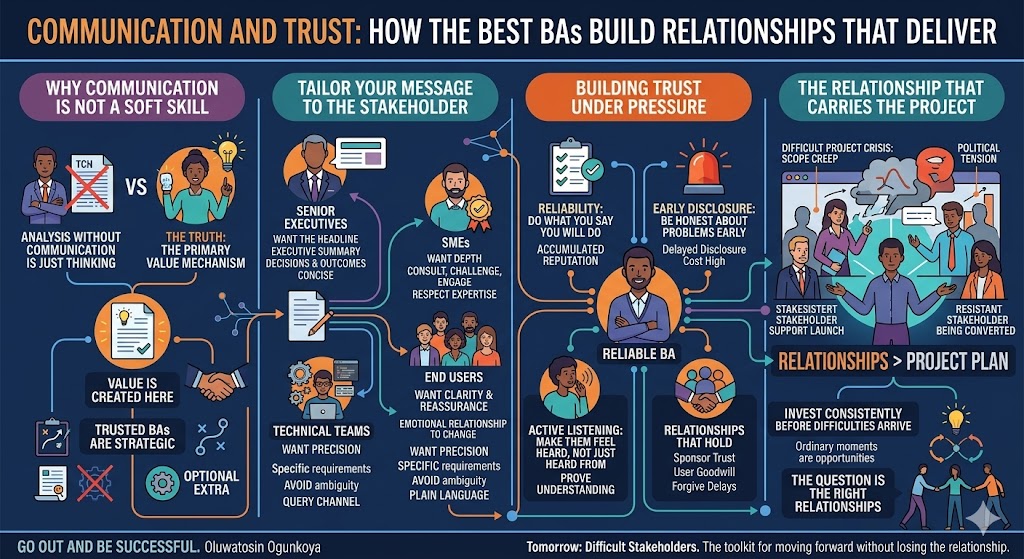
There is a version of communication that most Business Analysts practise, and there is a version that the best BAs have mastered. The difference between them is not vocabulary, confidence, or presentation skills. It is intent.
The average BA communicates to inform. They send updates, produce status reports, run workshops, and send meeting notes. They are producing communication as an output of the project process.
The exceptional BA communicates to build. Every interaction with a stakeholder is an opportunity to deepen understanding, strengthen alignment, or reinforce trust. They are not just transmitting information. They are investing in the relationship that will carry the project through its difficult moments. Every project has difficult moments. The question is whether the relationships you have built are strong enough to hold when they arrive.
Why Communication Is Not a Soft Skill
The label soft skill has done enormous damage to how the BA profession thinks about communication. It places communication in a category of optional extras, nice-to-have attributes that complement the real work of requirements, documentation, and analysis.
This framing is wrong, and it is costly. Communication is not the supporting act to your analytical work. For a Business Analyst, it is the primary mechanism through which all analytical work creates value. A perfectly constructed requirements document that the development team does not understand has no value. A brilliant stakeholder analysis that you cannot act on because you have not built the relationships to have the necessary conversations has no value. Analysis without communication is just thinking.
The BAs who are trusted with the programmes that matter are the ones who have mastered communication as a strategic discipline, not a social nicety. They think about it deliberately, plan it carefully, and adapt it continuously based on what they observe in their stakeholder relationships.
Tailoring Your Communication to the Stakeholder
The single most important communication principle for a Business Analyst is this: the message that matters is the one the stakeholder receives, not the one you sent. The same information, communicated in the same way to two different stakeholders, will produce two entirely different responses. Stakeholders have different backgrounds, different levels of technical literacy, different priorities, different pressures, and different relationships with the project. One-size communication does not fit all of them.
Senior executives want the headline. They want to know what is happening, what decisions are needed, and what it means for the outcomes they care about. A ten-page status report with detailed technical content is not communication for a C-suite stakeholder. It is documentation that creates the risk of their reading the wrong part and drawing the wrong conclusion. Give them a concise executive summary: what is on track, what is at risk, what you need from them, and what happens next.
Subject matter experts want depth. They are the people who understand the details of the business operations your project is changing. They do not want to be talked at in executive summaries. They want to be consulted, challenged, and engaged as the experts they are. When you communicate with your SMEs, show that you have done your homework. Ask specific questions. Invite pushback. The SME who feels genuinely respected will tell you things in a one-to-one conversation that they will never say in a workshop.
End users want clarity and reassurance. Their relationship with change is often primarily emotional, not analytical. What does this mean for me? Will I be able to do my job? Will my role change? Will it get harder? These are the questions running through their minds even when they are asking something technical. Communicate with end users in plain language, be honest about what will change and what support they will have, and do not underestimate how much goodwill you can build simply by treating them as people rather than a deployment audience.
Technical teams want precision. Ambiguity is their enemy. When you communicate requirements to a development team, vague language creates interpretation risk. Be specific. Define terms. Use examples. And create a clear, easy channel for them to raise queries before they make assumptions. An assumption made by a developer in week four of a sprint, because they could not get a clear answer, is a defect waiting to be discovered in testing.
Building Trust Under Pressure
Trust between a Business Analyst and their stakeholders is built in ordinary moments and tested in difficult ones. The daily habits of communication that you maintain when things are going well determine how much trust you have available to draw on when things go wrong.
The habits that build trust are consistent, and they are not complicated. Do what you say you will do. If you commit to sending a summary by the end of business Friday, send it by the end of business Friday. Not because anyone will necessarily notice, but because the accumulated weight of kept commitments builds a reputation for reliability that is extraordinarily difficult to build any other way.
Be honest about problems early. The instinct to wait until you have a solution before telling a stakeholder about a problem is understandable. Nobody wants to walk into a sponsor's office with bad news and no answers. But the cost of a delayed disclosure is almost always higher than the cost of an early one. Stakeholders who discover problems late feel blindsided. They lose confidence not just in the project but in the BA. Whereas a stakeholder who hears about a problem early, alongside an honest assessment of the situation and the options being considered, typically responds with engagement rather than anger.
Make stakeholders feel heard, not just heard from. There is a difference between listening and demonstrating that you have listened. When a stakeholder raises a concern, the response that builds trust is one that proves you understood what they said. Not just a nod and a note, but a genuine acknowledgement of the concern, a clear statement of what you are going to do about it, and a follow-up that closes the loop. A stakeholder who has been heard will give you the benefit of the doubt when things are uncertain. A stakeholder who has been heard from but not actually listened to will remember every instance when their input was sought and then ignored.
Managing Expectations Before They Become Problems
Most stakeholder communication problems are expectation management failures. A stakeholder who feels disappointed, surprised, or let down by a project outcome almost always had an expectation that was not properly managed somewhere along the way.
Expectation management is not about telling stakeholders what they want to hear. It is about ensuring that what they expect to receive is aligned with what you are actually going to deliver. When those two things are misaligned, the gap between them will eventually surface. The later it surfaces, the more damage it causes.
The BA's job is to surface those gaps as early as possible and address them directly. This sometimes means having uncomfortable conversations: telling a stakeholder that the feature they are expecting is out of scope, that the timeline they have been told about is not realistic, or that the level of change their team is being asked to absorb is higher than they have been led to believe. These conversations are not easy. But they are almost always less painful when they happen early than when they happen late. A stakeholder who is told in month two that their expectation cannot be met has time to adapt, reprioritise, and engage in a constructive conversation about what can be delivered. A stakeholder who discovers the same thing in month six has a problem, and they may decide to make it yours.
What a Practical Stakeholder Communication Plan Looks Like
A stakeholder communication plan is not a spreadsheet listing every stakeholder and ticking a box for email or meeting. That is a contact list with extra columns. A genuine communication plan answers six questions for each key stakeholder or group. What do they need to know? When do they need to know it? How should it be communicated (format, channel, tone)? Who is responsible for communicating it? What response or action do you need from them? And how will you know whether the communication has been effective?
That last question is the one most plans miss entirely. Communication effectiveness cannot be assumed from the fact that an email was sent. It requires a feedback mechanism. Did the stakeholder understand the message? Did they take the expected action? Are they still aligned with the project direction? If you are not checking, you are broadcasting, not communicating. The most effective communication plans I have seen are light on documentation and heavy on intention. They do not try to script every interaction. They establish a rhythm, a set of principles about how different stakeholders will be engaged and how communication will flow, and then they are adjusted based on what is actually working.
The Relationship That Carries the Project
Every significant project will hit a moment when something goes wrong, when the scope needs to change, when a key stakeholder becomes uncomfortable, when the political landscape shifts and the project's position becomes vulnerable. What determines whether the project survives those moments is rarely the quality of the project plan. It is the strength of the relationships the BA has built with the people who have the authority and the influence to keep the project moving.
A sponsor who trusts you will give you the space to solve problems. A user community that feels respected will forgive a delay. A resistant stakeholder who knows you have listened to their concerns is far easier to bring back to the table than one who has never felt heard.
Build those relationships before you need them. Invest in them consistently, through the ordinary moments of the project, through the updates and the workshops and the conversations that do not feel significant at the time. Because when the difficult moment comes, and it always does, the question will not be whether you have the right answer. It will be whether you have the right relationships.
Go out and be successful.
Oluwatosin Ogunkoya
Tomorrow: Difficult Stakeholders. The types of resistance you will face, what drives them, and the BA toolkit for moving forward without losing the relationship.