
Day 4 · Stakeholder Management Mastery: The Skill That Makes or Breaks Projects
Difficult Stakeholders: Conflict, Resistance and How to Move Forward Without Losing the Relationship
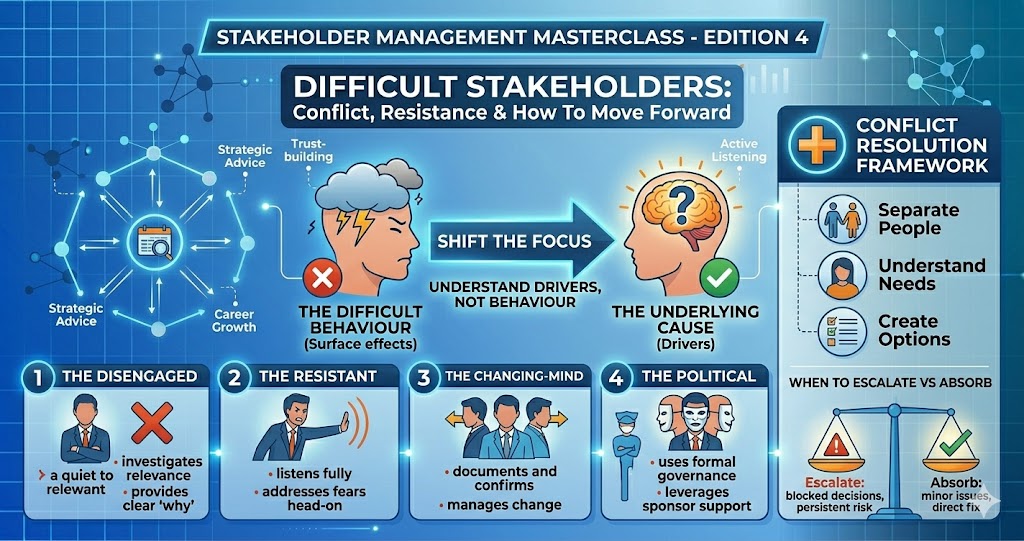
I want to start with something that took me a few years and some painful project experiences to fully understand. Difficult stakeholders are rarely difficult people. The sponsor who keeps changing requirements is usually not being obstructive. They are responding to information they are receiving from the business that the project has not been designed to accommodate. The subject matter expert who never attends workshops is not disengaged. They may have been told informally that their job is at risk because of the project they are being asked to help shape. The senior leader who undermines the project in steering committees may have a legitimate political concern that nobody has ever given them a safe space to voice.
When you understand what drives difficult behaviour rather than just experiencing its effects, your entire approach to managing it changes. You stop trying to manage the behaviour and start trying to address the underlying cause. And when you address the cause, the behaviour almost always changes. That is the foundation this article is built on. Let us look at the most common types of difficult stakeholder behaviour, what actually drives them, and how to respond.
Type 1: The Disengaged Stakeholder
Symptoms: Does not attend meetings, responds to communications slowly or not at all, sends delegates who cannot make decisions, and seems indifferent to the project's progress.
What usually drives it: Overcommitment, not enough perceived relevance, or a previous experience with projects that wasted their time. In some cases, disengagement is a signal of passive resistance. The stakeholder has concerns about the project but has decided that disengaging is safer than voicing them.
How to respond: Start by investigating before you intervene. Is the disengagement general or specific to your project? Have you made the relevance of their involvement explicit? Many stakeholders disengage not because they do not care but because nobody has clearly explained why their engagement matters, what specifically you need from them, and what will happen if you do not get it.
A one-to-one conversation, informal and low-stakes, is almost always more effective than escalating through the formal project governance chain. Go to them. Ask directly whether there is anything about the project or the process that is making engagement difficult. Give them permission to be honest. You may hear something that changes how you have been thinking about the project entirely.
If disengagement continues after a genuine attempt at direct engagement, that is a signal to escalate to your sponsor. Not as a complaint about the stakeholder, but as a risk to the project. Frame it analytically: this person's input is required for this decision. We have not been able to secure their engagement. Here is the risk to the project if this continues, and here is what I need from you to resolve it.
Type 2: The Resistant Stakeholder
Symptoms: Actively argues against the project in meetings, finds fault with every proposal, influences others to be sceptical, and raises the same objections repeatedly even after they have been addressed.
What usually drives it: Fear. Almost always, at its root, resistance to change is driven by some version of fear. Fear that the change will make things worse. Fear that their expertise will be devalued by the new process. Fear that their team will struggle to adapt. Fear of losing influence, status, or control. People rarely resist change for the sake of it. They resist it because they can see something they stand to lose that they do not believe the project is taking seriously.
How to respond: Listen before you push back. When a resistant stakeholder raises an objection, the instinct is to address it head-on with evidence. Resist that instinct. Before you defend the project, make sure you understand the objection fully. Ask questions. What specifically concerns you about this approach? What would need to be true for you to feel comfortable with this direction? What have you seen in previous projects that makes you cautious here?
You are doing two things at once. First, you are gathering information that may actually be valuable, because the resistant stakeholder is often the one who has spotted a genuine problem that others are too comfortable to raise. Second, you are demonstrating that their concern has been heard and taken seriously, which is itself a trust-building act.
Once you genuinely understand the concern, address it directly. Not with a dismissal, but with a substantive response. If the concern is valid, acknowledge that and explain how you are going to address it. If the concern is based on a misunderstanding, explain the misunderstanding clearly and check whether the correction resolves it. If the concern reflects a fundamental disagreement about the project direction, that is a governance conversation, not a stakeholder management conversation, and it needs to go to the appropriate decision-making forum.
Type 3: The Changing-Mind Stakeholder
Symptoms: Agrees to a requirement in a workshop, then raises new concerns in the next meeting, then approves something in a sign-off review and then wants to change it again. Requirements creep, revisited decisions, and the sense that no agreement is ever final.
What usually drives it: In many cases, this is not deliberate inconsistency. The stakeholder is receiving new information from their organisational context between your interactions. Something changes in the business environment, a conversation with a colleague, a shift in executive priorities, a concern raised by someone whose opinion they value, and they bring that new information into your next interaction in the form of changed requirements.
In other cases, it reflects insufficient clarity during the original conversation. The agreement was recorded, but the stakeholder's understanding of what was agreed was not the same as yours. This is more common than most BAs like to admit.
How to respond: Documentation and confirmation are your primary tools here. Every agreed requirement, every approved decision, and every signed-off deliverable should be captured in writing and confirmed with the stakeholder explicitly. Not as a bureaucratic exercise but as a shared record of the conversation and its outcomes. When requirements change, treat them as change management events. What has changed? Why has it changed? What is the impact on scope, timeline, and budget? Is this change within the agreed change management process? Making the cost of change explicit and formal is not punitive. It is professional. It protects the project, and it protects the stakeholder from making changes they have not fully considered the consequences of.
Type 4: The Political Stakeholder
Symptoms: Says what you want to hear in one-to-one meetings and then undermines the project in steering committees. Appears to support the project in public while working against it through back channels. Raises concerns for your sponsor without raising them with you first.
What usually drives it: Organisational politics. This stakeholder has interests and relationships that go beyond the project, and the project has landed in the middle of a political landscape that you may not fully understand. Their behaviour is not primarily about the project. It is about their position within the organisation and the relationships they are trying to protect.
How to respond: This is the most complex stakeholder challenge because the drivers are often not transparent, and the project levers are limited. There are some things that are within your control and some that are not.
What is within your control: Ensuring that your sponsor understands the dynamics and is actively engaged in navigating them with you. Making the formal governance channels robust enough that political undermining is less effective. Continuing to engage the stakeholder directly and professionally, regardless of what you suspect is happening behind the scenes, because withdrawing from the relationship will not improve it.
What is not within your control: The organisation's political landscape itself. The history between individuals. The power structures that existed before your project started and will exist after it ends. Do not waste energy trying to change organisational politics. Spend it on understanding them well enough to navigate around them.
Conflict Resolution: A Framework the BA Can Use
When stakeholder difficulties escalate into genuine conflict, whether between the BA and a stakeholder or between stakeholder groups, a structured approach to resolution is more effective than managing the situation ad hoc.
The first step is to separate the people from the problem. Most conflicts feel personal but are actually substantive. There is a genuine disagreement about scope, priority, ownership, or approach underneath the emotional dynamic. Bringing the conversation back to the substantive issue, away from the personalities and the history, is the first move.
The second step is to understand what each party actually needs, as distinct from what they say they want. These are often different things. A stakeholder who says they want a particular requirement included may actually need reassurance that their team's workload is being considered. Addressing the need rather than debating the stated want is usually the path to resolution.
The third step is to create options rather than positions. A conflict where both sides have declared positions is very difficult to resolve, because moving off a position feels like losing. A conversation where both sides are generating options together does not have winners and losers. It has solutions.
When to Escalate and When to Absorb
Not every difficult stakeholder situation requires escalation, and one of the most valuable judgment calls in senior BA practice is knowing the difference between situations you should absorb and situations you should escalate.
Absorb when: the behaviour is annoying but not materially affecting delivery, a direct conversation is likely to resolve it, or escalation would damage the relationship more than the behaviour itself.
Escalate when: the behaviour is creating a risk to the project that cannot be managed at the BA level, key decisions are being blocked without a valid reason, or the BA has made repeated genuine attempts to resolve the situation directly, and they have not worked.
Escalation should always be framed as a risk to the project, not a complaint about an individual. You are not asking your sponsor to manage someone. You are asking them to help you manage a situation. That framing matters. It keeps the conversation professional, it puts the focus on the project outcome rather than the personality, and it is more likely to get the result you need.
The goal of every difficult stakeholder interaction is the same: to find a way to move the project forward while preserving the relationship. The two are not mutually exclusive. The BAs who are best at navigating difficult stakeholders are not the ones who win every argument. They are the ones who find a way to make every stakeholder feel respected, even when the answer is no.
Go out and be successful.
Oluwatosin Ogunkoya
Tomorrow: Series Finale. Stakeholder mastery in your career, interview preparation with model answers, and your free downloadable Stakeholder Management Toolkit.