
Seven Schedule Mistakes New Project Owners Make, and the One-Page Toolkit
Most schedule problems are one of these seven, and all seven are avoidable.
Almost every analyst who takes on a delivery date makes some of the same mistakes, and almost none of them are about intelligence or effort. They are habits that serve a requirements owner well and cost a schedule owner dearly. Seven of them cause most of the damage, and each has a simple fix. If you are joining us on day five, here is where we are. This week is five tools for the business analyst who now owns a delivery date. We have covered five shifts in thinking, a work breakdown with three-point estimates, a six-step route from requirements to dated plan, and an eight-question checklist for the moment someone asks for a date. Today we collect the common mistakes, and finish with a one-page toolkit that holds the whole week.
Seven mistakes and how to avoid them
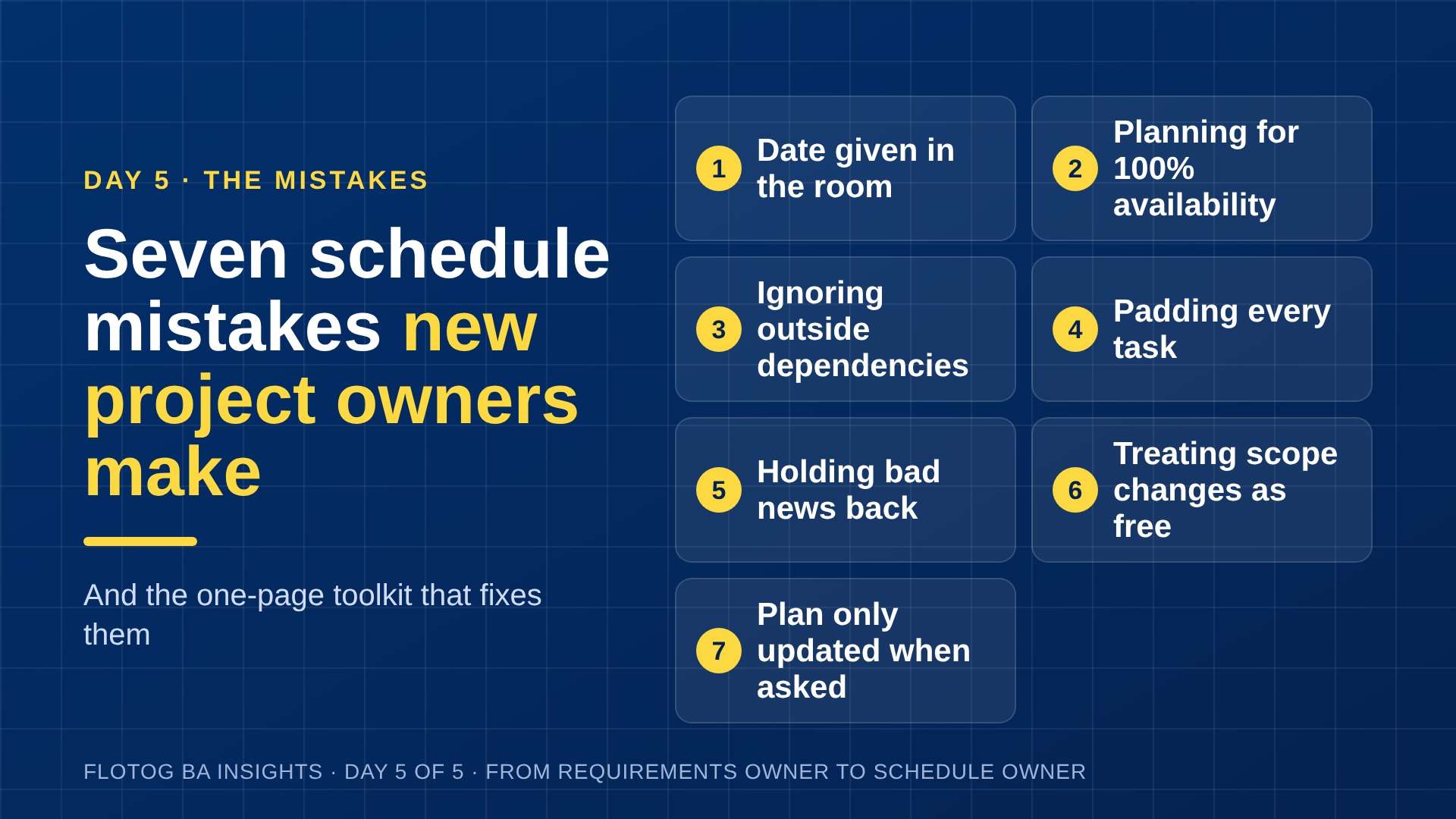
- Giving the date in the room. The pressure to answer immediately is real, but an answer given before you have checked scope, people and dependencies is a hope. Say you will confirm by tomorrow, and use the eight questions to earn the answer.
- Planning for 100% availability. Nobody spends every hour of a working week on one project. Meetings, leave, support work and context switching take a share. Ask people how many days a week they can truly give, and plan with that number.
- Ignoring dependencies outside the team. The tasks you control are rarely what makes you late. A supplier, another team or an approver usually is. List every external dependency, give each a named owner and a date, and check on them before they are due.
- Padding every task. Small cushions on each estimate feel careful, but people fill whatever time is available, so the cushion disappears. Keep estimates honest and hold one visible buffer at the end of the critical path.
- Holding bad news until it is certain. Analysts like to be sure before they speak. A schedule owner who waits for certainty gives bad news when it can no longer be fixed. Report a risk when it becomes likely, with the options, and let people help.
- Treating scope changes as free. A small addition always feels small. Several together are how projects drift. Every change should come with a statement of its effect on the date, even when the answer is "none", so that the habit is in place when it matters.
- Updating the plan only when someone asks. A plan that is out of date is a source of false comfort. Set a regular rhythm, such as a short weekly update, and check the critical path, the buffer and the open dependencies each time.
Several of these come from the same root: the instinct to look finished and confident. In requirements work that instinct is mostly harmless, because a clear document is the goal. In scheduling, it pushes people to quote a tidy date too early, to avoid unwelcome news and to protect the plan from change. The fix in every case is to show the uncertainty earlier and more plainly, which is uncomfortable for a week or two and then becomes the reason people trust you.
What does a good routine look like once the mistakes are out of the way? A short weekly update is enough: where the critical path stands, how much of the buffer is left, which dependencies are due in the next two weeks, and what has changed in scope. Keep it to a few lines, send it at the same time each week, and include the news you would rather not send. People stop worrying about a schedule owner who reports steadily, because they know that silence means all is well and that anything else will be flagged. That reputation is worth more than any single date you ever get right.
The week in one page
THE FIVE TOOLS OF THE WEEK
| Tool | Use it when | Day |
|---|---|---|
| Five shifts | You are taking on a date for the first time | Mon |
| Work breakdown and three-point estimates | A task is too big or vague to estimate | Tue |
| Six steps from list to dated plan | You have estimates and need a plan | Wed |
| Eight questions before a date | Someone asks "when will it be done?" | Thu |
| Seven mistakes | You are reviewing a plan or a week gone wrong | Fri |
Keep this table where you plan. It is the whole week in five lines.
Used in order, the tools form a simple loop. The shifts tell you how to think. The breakdown and the three-point ranges give you honest estimates. The six steps turn estimates into a plan. The eight questions protect you when you have to commit. The seven mistakes are what to look for when something starts to go wrong. You do not need all five on every task, and for a small piece of work the first three may be enough.
How to practise this without a project
You do not need to be a project manager to practise, and the best time to learn is before the pressure arrives. Take a piece of work you are already doing, such as a report, a workshop, a document set or a small change. Break it into tasks, give each a best, likely and worst estimate, draw what waits on what, and find the longest chain. Then compare your plan with how the work really goes. The gaps between plan and reality are the lessons, and a few small exercises teach more than any article.
Keep a short record as you practise. Write down your estimate before you start, then the time the work really took, and what caused the difference. After ten or so tasks you will see patterns, such as always underestimating testing or forgetting handover. Those patterns are specific to you, and correcting for them is the quickest way to get better. Analysts who do this for a few months usually find their estimates move from wildly optimistic to reliably close, without any extra effort beyond the habit of looking back.
It also helps to ask someone to challenge your plan. A colleague who has run projects can usually spot a missing task or a hidden dependency within minutes. Invite the challenge before you commit, and thank the person who finds the hole, because an unfound hole is far more expensive later. Over a few months, this habit builds the judgement that separates a reliable schedule owner from a hopeful one.
That closes the week. Whether or not you choose the title of project manager, the ability to estimate honestly, plan sensibly and report early makes you more useful in any role. Next week we move to a different topic altogether, one every business analyst should be able to speak about with confidence: cybersecurity literacy, and what to ask when a requirement touches sensitive data.
Go out and be successful.
Oluwatosin Ogunkoya · Flotog BA Insights · 1:1 mentoring and coaching for BAs at every career stage · www.flotogbainsights.com
NEXT WEEK
Cybersecurity Literacy for Business Analysts - What to ask, and what to write into requirements, when a system touches sensitive data.