
Eight Questions to Ask Before You Commit to a Date
The date you give in the first meeting is usually the one you regret.
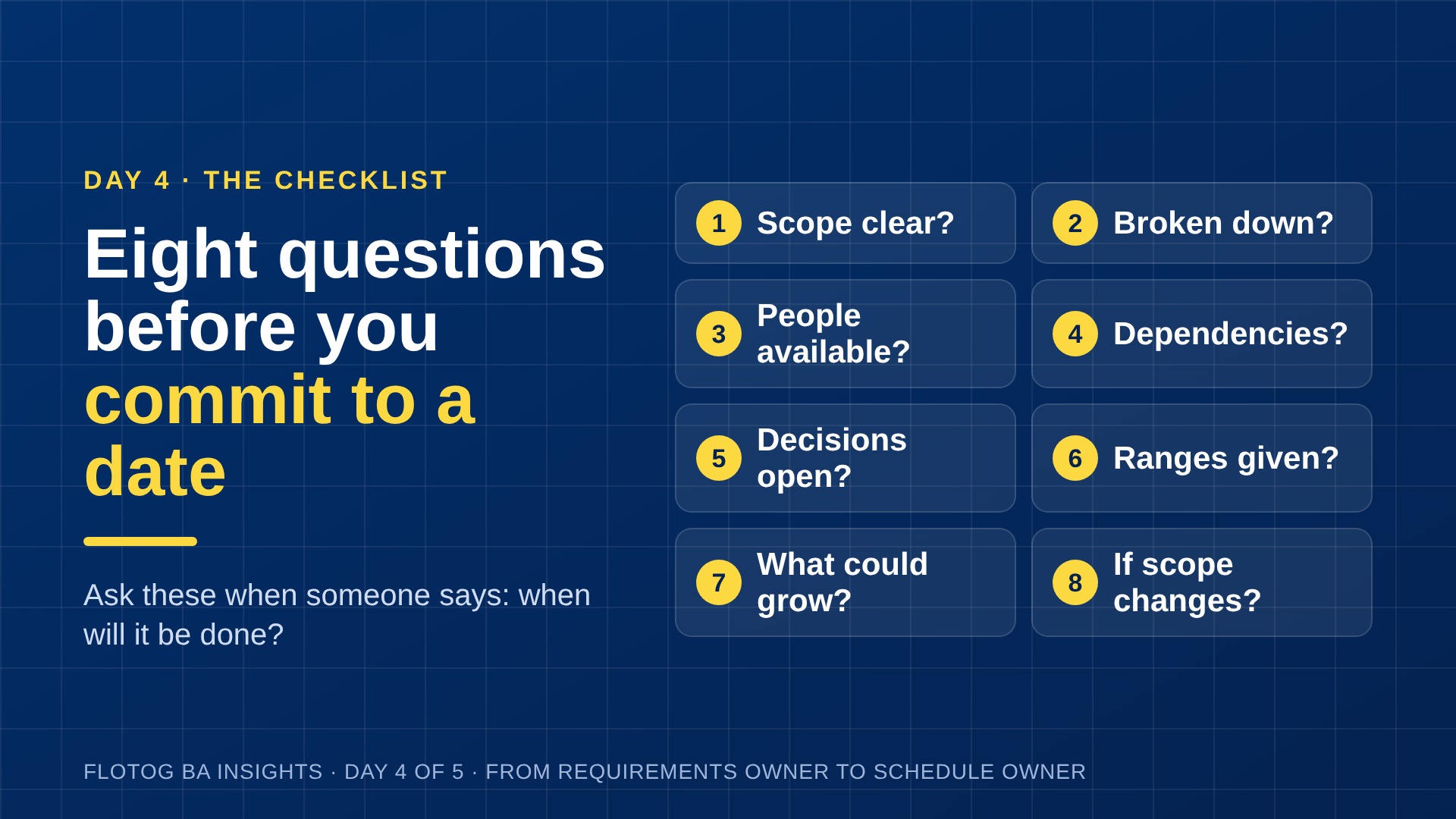
"When will it be done?" is the most expensive question in project management, because the answer given in the first minute is usually the one people hold you to. A schedule owner who answers instantly is nearly always guessing. One who asks a few questions first sounds slower and is almost always right more often. If you are joining us on day four, here is where we are. This week is five tools for the business analyst who now owns a delivery date. We have covered five shifts in thinking, how to break work down into estimable tasks, and how to turn estimated tasks into a dated plan with a critical path and a buffer. Today's tool is a checklist for the moment someone asks for a date before you have had time to build all of that.
Why the first answer is usually the wrong one
People ask for a date at awkward moments: at the end of a meeting, in a corridor, in a message with several other questions. The pressure to answer quickly is real, and the person asking is rarely trying to trap you. They need a number to plan around, and silence feels like a problem.
The trouble is that an early answer is made when you know the least. Scope may still be moving, nobody has checked who is available, and the dependencies on other teams have not been mapped. A date offered under those conditions is a hope, and a hope repeated in a status meeting becomes a commitment. Later, when the facts arrive, the choice is between moving the date and explaining a miss.
A short list of questions solves this in two ways. It improves the answer, because you find the weak points before you commit. And it changes the tone of the conversation, because "let me check eight things and come back to you by tomorrow" sounds like competence, not delay. Most sponsors prefer a reliable date a day later to an optimistic one now.
The eight questions
- What exactly is in scope, and what is not? If the answer is not written down, the date is attached to something nobody can describe.
- Has the work been broken down far enough to estimate? If the biggest tasks are still described in a few words, the estimates beneath them are guesses.
- Who will do each piece, and how much of their week is really available? Ask for a number, not an assurance. Someone who is nominally on the project but has other duties will deliver more slowly than the plan assumes.
- What does each piece wait on, inside and outside the team? Anything that depends on another team, a supplier or an approval needs a name and a date from the owner of that dependency.
- Which decisions or approvals are still open, and who owns them? An undecided question often hides a larger piece of work than anyone has admitted.
- What is the range for each estimate, not only the likely figure? A date built on likely figures alone has no room for the ordinary variation that every project meets.
- What could make this bigger, and has anyone said it out loud? Name the top three risks. Those become the conditions you attach to the date.
- What happens to the date if scope changes? Agree in advance that a change in scope is a conversation about the date, so that the date does not quietly stretch while the work grows.
You will not always have good answers to all eight, and that is the point. Each question you cannot answer is a piece of uncertainty you have found before it found you. Where the answers are thin, the date should be offered with conditions, or offered later.
In practice you can run the whole checklist in about ten minutes for a small piece of work, and in an hour or two for a larger one. Do it on paper or in a shared note, answer each question in a sentence, and mark the ones you could not answer. Share the marked list with the person asking, because it explains your reply better than any reassurance. Over time you will find that three or four of the questions catch most of your problems, and those are the ones to ask first when time is short.
What to do when the answers are not good
The checklist is only useful if it changes what you say. The table below pairs the most common weak answers with a response that keeps you honest and keeps the conversation moving. None of them is a refusal. Each gives the person asking something they can plan around.
WHEN AN ANSWER IS WEAK, HERE IS WHAT TO SAY ABOUT THE DATE
| What you found | What you say |
|---|---|
| Scope is not agreed | I can give you a date for the scope decision, and a delivery date once it is made. |
| A dependency is outside your control | I can commit to my part, and the date holds if the other team delivers by a stated day. |
| A key person is only part-time | I will give the date in elapsed time, based on their real availability, not full-time effort. |
| Estimates are single numbers | Give me until tomorrow to turn them into ranges, and I will come back with a date and its conditions. |
Each reply gives a date or a date for the date, together with the condition it depends on.
Notice the pattern in every reply. You are not saying no, and you are not saying yes. You are attaching the date to the thing it depends on, so that if the condition fails, everyone already knows what that means. This is what the second shift from day one looks like in practice: moving from describing to committing, while keeping the conditions attached.
It helps to write the conditions down and send them as a short message after the conversation. Something like: "Confirming what we discussed: the target is the end of the month, assuming scope is agreed by Friday and the other team delivers their part by the 10th. I will confirm or update this next week." That message costs two minutes and turns a casual remark into a shared record, which protects both you and the person who asked.
Finally, practise this on small questions before you need it on large ones. The next time a colleague asks how long something will take, run through the list in your head and see which of the eight you can answer. You will quickly learn which questions you tend to skip, and that is the most useful finding of all. Tomorrow closes the week with the common mistakes new schedule owners make, and a one-page toolkit that gathers everything into a single place.
Go out and be successful.
Oluwatosin Ogunkoya · Flotog BA Insights · 1:1 mentoring and coaching for BAs at every career stage · www.flotogbainsights.com
TOMORROW
Seven Schedule Mistakes, and the One-Page Toolkit - What new schedule owners get wrong, and the week's tools gathered on one page.