
Five Shifts When You Go From Owning Requirements to Owning the Schedule
The five shifts, and what each one asks you to stop doing
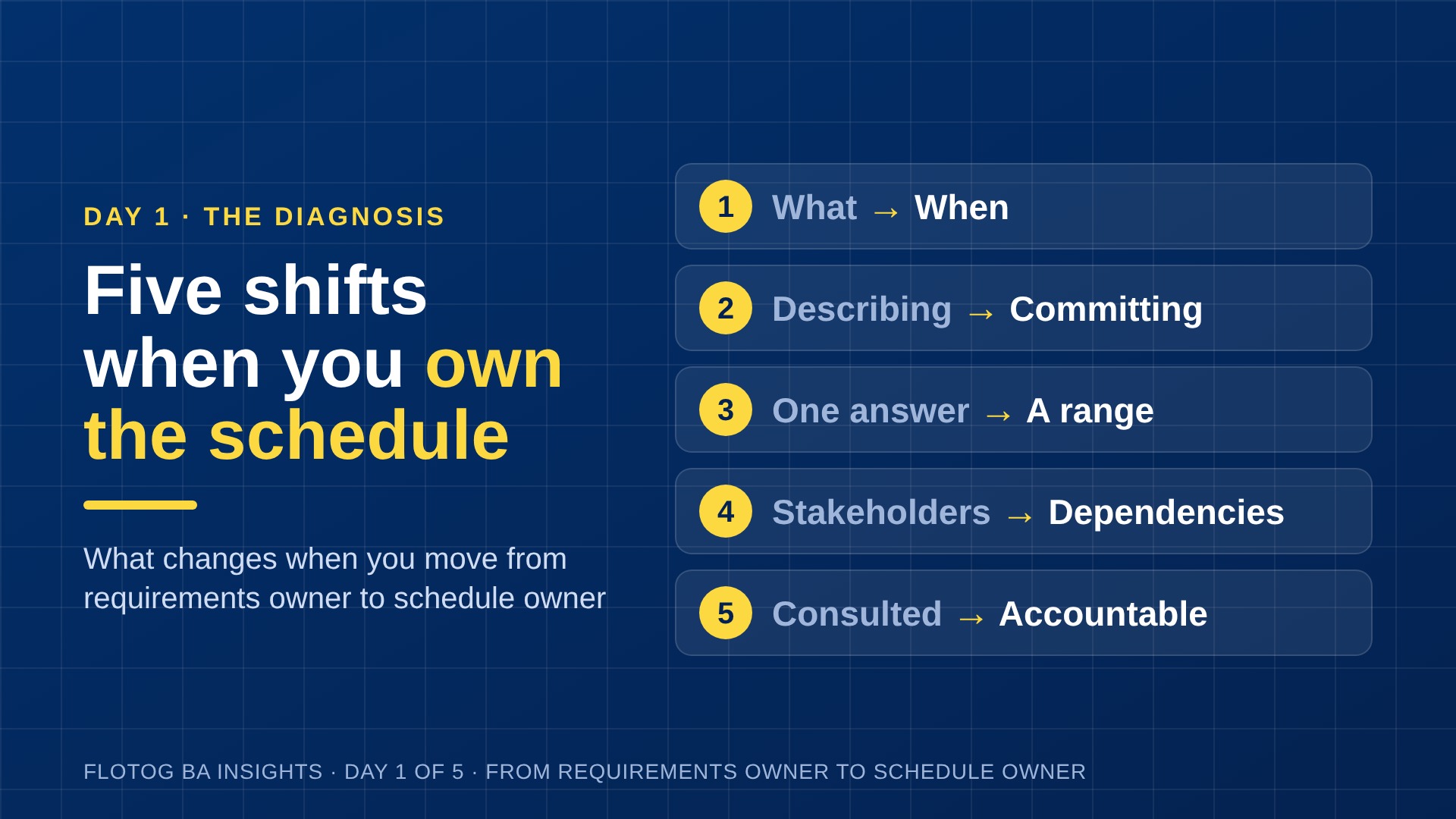
A business analyst is judged on whether the requirements are right. A schedule owner is judged on whether the date holds. The two jobs sit next to each other on an org chart, and they feel like neighbours, but they reward different habits. Analysts who step into project management without noticing the difference tend to bring excellent habits to a job that needs others. This week is five days and five tools for the business analyst who has just been handed a deadline as well as a requirements document. Today we name the five shifts in thinking. Tuesday turns to breaking work down so it can be estimated. Wednesday builds a dated plan from a list of requirements. Thursday gives you a checklist for the moment someone asks for a date. Friday covers the common mistakes and closes with a one-page toolkit you can keep.
Why the move feels harder than it looks
On paper, the step from business analysis to project management looks small. You already talk to stakeholders, you already know what the project is meant to deliver, and you already write things down clearly. Many analysts are asked to take on a schedule precisely because they know the work better than anyone else on the team, and that is a fair reason to ask.
The difficulty is that the two jobs are measured differently. A requirements owner is measured on understanding: did you find out what the business needs, and did you describe it so that others can build it? Misunderstandings are expected, and the craft lies in finding them early and correcting them. Nobody thinks less of an analyst who says the requirement has changed because the team learned something.
A schedule owner is measured on a promise. Once a date has been said aloud in front of a sponsor, it stops being an estimate in the listener's mind and becomes a commitment. If it moves, the schedule owner is asked why, and the honest answer, which is usually that nobody knew enough at the time, sounds like an excuse. The skill is not in knowing the answer. It is in knowing how much you do not know, and saying so in a way that people can plan around.
That difference is the root of all five shifts below. Each one takes a habit that serves a requirements owner well and asks you to adjust it, not to throw it away. The aim is not to stop being an analyst. It is to carry the analyst's strengths into a role where the same strengths need a different shape.
The five shifts
THE FIVE SHIFTS, SIDE BY SIDE
| Shift | As requirements owner | As schedule owner |
|---|---|---|
| 1. What to when | What does the business need, and why? | What must be finished, in what order, by whom, and by when? |
| 2. Describing to committing | This is our current understanding. | This is the date, and I will tell you early if it moves. |
| 3. One answer to a range | Find the correct requirement. | Give a realistic range and say what drives it. |
| 4. Stakeholders to dependencies | Who cares about this, and what do they want? | What waits on what, inside and outside the team? |
| 5. Consulted to accountable | Asked for input when needed. | Asked every week whether we are on track. |
Each shift keeps an analyst strength and changes what it is pointed at.
The first shift is from what to when. As an analyst, your central questions are about the business need: what is wanted, who wants it and why. A schedule owner still cares about those, but the daily questions become sequence and time. What has to be finished before something else can start? Who is doing it? When will it be done? A good test of whether you have made this shift is whether you can look at a requirements list and see the order of work hiding inside it.
The second shift is from describing to committing. Requirements documents are full of careful language because requirements are expected to change as understanding grows. A schedule uses the opposite register. People want a date they can plan around, and they will remember it. This does not mean refusing to qualify a date. It means attaching the conditions to it, such as what you assumed, what you are waiting for and when you will confirm it, so that the date and its conditions travel together.
The third shift is from one answer to a range. Analysts are trained to find the right answer, and in requirements work there often is one. Estimates do not work like that. Any estimate for work that has not been done yet is a guess with a spread around it, and giving a single number hides the spread. Tuesday shows a simple way to give a likely figure together with a best case and a worst case.
The fourth shift is from stakeholders to dependencies. A stakeholder map shows who is affected. A dependency map shows what is waiting on what, and much of it sits outside your team: a supplier delivering something, another team releasing a change, an approval from someone with a full diary. Delays tend to come from the dependencies nobody wrote down. The fifth shift is from being consulted to being accountable. Analysts are asked for input. Schedule owners are asked every week, often every day, whether the project is on track. The habit to build is knowing the answer before anyone asks, and giving bad news while there is still time to act on it.
What to do with this on Monday morning
Reading about shifts is easy and changing habits is slow, so pick one. Choose the shift that you think will cost you most, and put one small practice against it this week. If the hard part for you is committing, practise saying a date together with its conditions in your next status conversation. If it is ranges, take the next estimate you are asked for and give three numbers, not one. If it is dependencies, list everything your current piece of work is waiting on that someone outside your team controls.
It also helps to talk to someone who already holds the role. Ask a project manager you trust what the first month felt like and which habit they had to unlearn. Most are happy to answer, and the answers are usually more specific and more honest than anything written in a textbook. A short conversation of this kind often saves months of finding out the hard way.
A last point for analysts who are not yet sure they want the move. You do not have to decide this week. The tools in this series are useful whether or not you ever carry the title, because analysts who can estimate, sequence and report honestly are trusted with more, in any role. Treat the week as practice for a skill that your future self will thank you for. Tomorrow is the first tool: how to break work down until each piece can be estimated honestly.
Go out and be successful.
Oluwatosin Ogunkoya · Flotog BA Insights · 1:1 mentoring and coaching for BAs at every career stage · www.flotogbainsights.com
TOMORROW
Break It Down Until You Can Estimate It - The work breakdown, three questions that keep an estimate honest, and why you give ranges.