
Eight Security Questions to Ask Before Sign-off
A short list that catches most gaps while they are still cheap to fix.
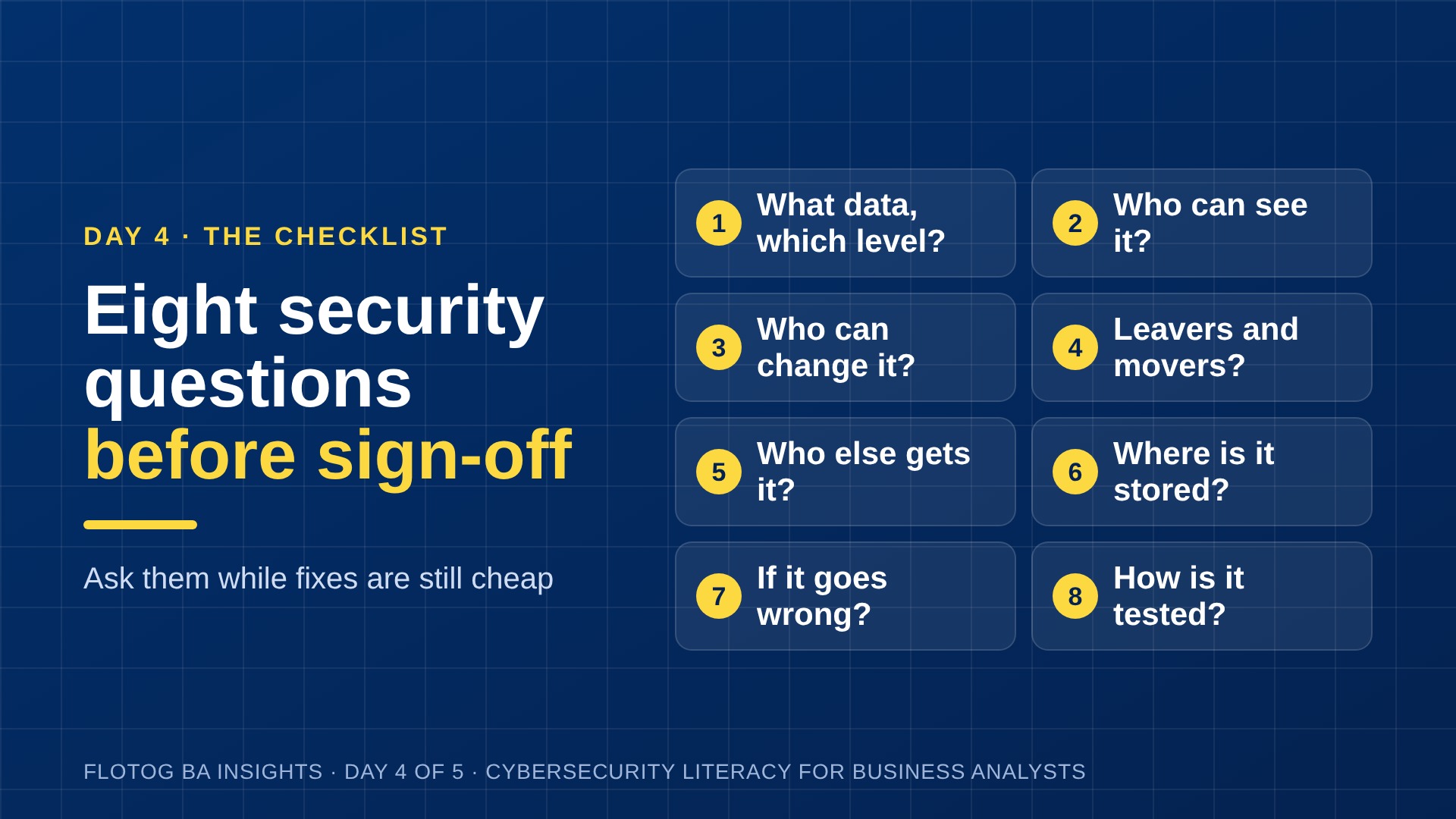
Security reviews usually happen at the end of a project, when changes are slow, costly and unwelcome. A short list of questions asked at sign-off catches most of the gaps while there is still time to fix them cheaply. You do not need to answer the questions yourself. You need to make sure that someone has. If you are joining us on day four, here is where we are. This week is five tools for business analysts who write requirements for systems that hold sensitive information. We have covered the three ideas behind most security requirements, a four-level way of classifying data, and how to write security requirements that can be tested. Today's tool is a checklist for the moment before a requirements set or a design is signed off.
Why ask at sign-off, and who to ask
Sign-off is the last natural pause before building or releasing, which makes it the last cheap moment to find a gap. After it, every change competes with deadlines and costs more. The point of the checklist is not to delay sign-off. It is to make sure that the questions have been asked and that the answers, including "we do not know yet", are written down by someone who owns them.
Ask three groups. The business owner can say what the data is worth and who should see it. The project team and the vendor can say how the system is built and what it does by default. The security or IT team can say what the organisation's policies require and whether anything conflicts with them. You are not asking them to give you a perfect answer. You are checking that an answer exists, that it has an owner, and that it matches what the requirements say.
Keep the exercise short. A checklist of eight questions can be run as a thirty-minute meeting with the right people in the room, or as a short written form sent to each group beforehand. The shorter it is, the more likely people are to answer honestly. Tell them it is about finding gaps early, not about blame, and say that an answer of "we do not know yet" is welcome because it can be acted on.
The eight questions
- What data does the system hold, and at what classification level? If the answer is "we have not classified it", return to the sorting exercise before going further.
- Who can see it, and who decides that? There should be a named list of roles and a named owner who approved it.
- Who can change or delete it, and is every change recorded? Look for who, when, and old and new values, in a log the editors cannot alter.
- How do people sign in, and what happens when someone leaves or changes role? Accounts that outlive the job they were created for are one of the most common gaps.
- Which other systems or companies receive the data, and how is it sent? Include integrations, reports, exports and any supplier with access.
- Where is the data stored, and how is it protected and backed up? Ask for the answer in writing from whoever runs the system.
- What happens when something goes wrong? Who is told, how quickly, and who decides what to do? An incident is the wrong moment to find out nobody owns it.
- How will the security requirements be tested before go-live? Each requirement should have a test, including a test that the wrong people are refused.
Two of the questions deserve extra patience. Question five, about who receives the data, tends to uncover integrations and suppliers that nobody mentioned in workshops, because they were set up by another team. Question four, about leavers, tends to reveal that no one owns account removal. Both are easy to overlook and both are worth a few minutes of digging before anyone signs anything.
You will not always get clean answers, and that is the purpose of asking. A question without an answer is a risk you have found before it found you. The next section looks at what to do with the weak answers.
If the system is being bought and not built, the same questions apply, but the answers come from a supplier. Ask for them in the supplier's own documents, such as a security statement or an independent assurance report, and check that what they cover matches what your requirements need. A report that covers the supplier's offices but not the product you are buying answers a different question.
What to do with weak answers
The checklist only helps if a weak answer leads to an action. The table below pairs the replies you are most likely to hear with a sensible next step. None of the steps involves refusing to sign off in a dramatic way. Each one turns a vague comfort into something that has an owner and a date.
WHEN AN ANSWER IS WEAK, HERE IS THE NEXT STEP
| What you hear | What to do next |
|---|---|
| We will sort that out later. | Record it as an open risk with an owner and a date. Do not close the requirement. |
| The vendor says it is secure. | Ask for the specific controls in writing, and who checks them. |
| Nobody owns that. | Raise it with the sponsor. An unowned risk is a finding in itself. |
| We have never tested that. | Add a test to the plan before go-live, and name who runs it. |
Each reply gives the weak answer an owner, a date or a test.
Tone matters when you ask. Phrases such as "help me understand how this works" or "what would we say if an auditor asked?" invite explanation, while "is this secure?" invites a defensive yes. People who run the system usually know where its weak points are and will tell an analyst who asks sincerely and does not seem to be testing them. The goal is a shared list of open items, not a verdict on anyone's work.
Record every open item in the same place as your other risks and issues, with the question, the answer given, the owner and the date by which it will be resolved. A short list like that is more persuasive to a sponsor than a general worry, and it protects you if a gap is found later, because it shows the question was asked at the right time.
A word on the human side. Many security incidents begin with a person being tricked, for example by a message that asks them to sign in on a false page, and not with a flaw in the system. Analysts cannot remove that risk, but they can ask whether the sign-in method resists it, whether unusual activity is noticed, and whether people know whom to tell. Tomorrow closes the week with the common gaps analysts leave in requirements, and a one-page toolkit.
Go out and be successful.
Oluwatosin Ogunkoya · Flotog BA Insights · 1:1 mentoring and coaching for BAs at every career stage · www.flotogbainsights.com
TOMORROW
Seven Security Gaps, and the One-Page Toolkit - The common gaps in requirements, and the week's tools gathered on one page.