
What a BA Actually Needs to Know About Security, in Plain Words
You are not the security expert. You are the person who has to ask the right questions.
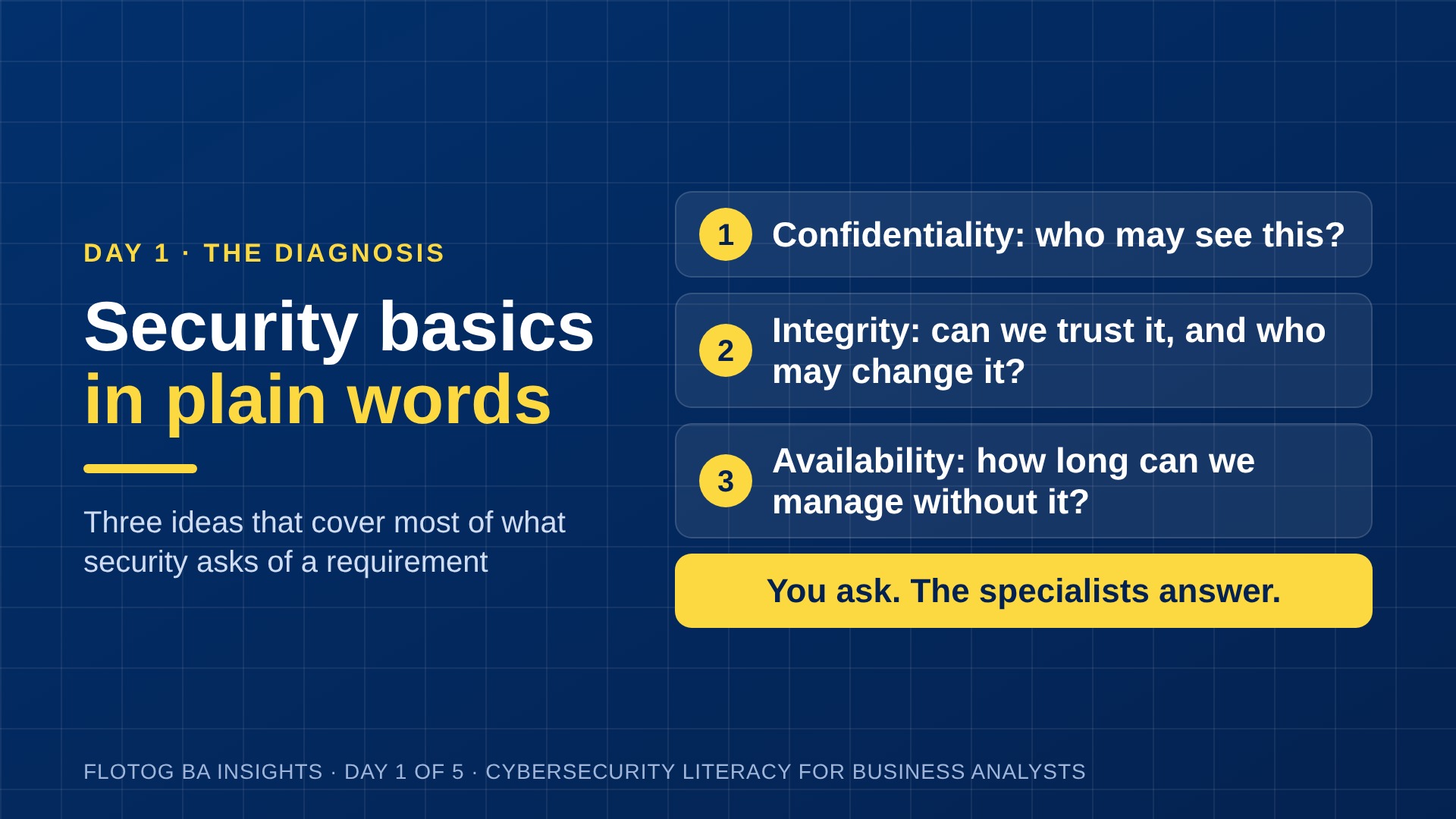
Security is rarely missing from a project because nobody cares about it. It is missing because nobody wrote it down as a requirement, and the business analyst is usually the person holding the pen. Developers build what the requirements say, testers test what they say, and a question that never made it onto the page is a question the system never answers. This week is five days and five tools for business analysts who write requirements for systems that hold sensitive information. Today we cover the three ideas that explain most of what security asks of a requirement. Tuesday gives you a way to decide how much protection each kind of data needs. Wednesday shows how to write security requirements that can be tested. Thursday is a checklist of questions to ask before sign-off, and Friday collects the common gaps and closes with a one-page toolkit.
Why security lands on the analyst's desk
Security feels like someone else's subject, and in an organisation with a security team it partly is. Those specialists set the policies, run the monitoring and respond when something goes wrong. What they cannot do is write requirements for a system they have not been told about, and they are often invited to review a design only after the main decisions have been made.
The analyst sits in a different place. You talk to the people who will use the system, you see the data it will hold, and you write down what it must do. That makes you the person best placed to notice that a screen will show salaries, that a report will leave the building as a spreadsheet, or that a supplier will need access to customer records. Nobody else sees all of that at the point where changing it is still cheap.
There is a second reason. Business users rarely ask for security, because they assume it. Nobody says in a workshop that only the right people should see the payroll data, since to them it is obvious. When an assumption is never written down, each person builds on a different version of it. A short, plain question from the analyst brings the assumption into the open before it becomes a gap.
None of this makes you responsible for protecting the organisation. It makes you responsible for something smaller and more achievable: knowing enough to ask the right questions, writing the answers down clearly, and knowing when to bring in the specialists. That is a skill, and it can be learned in a week.
Three words that cover most of it
Security professionals often describe their goals with three words, confidentiality, integrity and availability. They look like jargon, but each one turns into a plain question that an analyst can ask in any workshop. The table below pairs each word with its question and the kind of requirement it tends to produce.
THREE IDEAS, THREE QUESTIONS
| Idea | The plain question | A requirement it might produce |
|---|---|---|
| Confidentiality | Who should be able to see this, and who should not? | Only the HR Manager role can view salary fields. |
| Integrity | Can we trust that this data is accurate, and that changes to it are authorised? | Changes to bank details need approval and are recorded. |
| Availability | How long can the business manage if this is not working? | The system is available during working hours, with a stated recovery time. |
Illustrative examples. Each idea gives you a question to ask and a requirement to write.
Confidentiality is about keeping information away from people who should not have it. It covers the obvious cases, such as customer records and payroll, and the less obvious ones, such as draft plans, pricing and contracts. The analyst's contribution is to ask who the legitimate viewers are, role by role, and to write that down. Integrity is about the data being correct and about changes being intentional. It is what stops a mistyped figure, a careless edit or a deliberate manipulation from going unnoticed. The analyst's contribution is to ask who may change what, who approves it and what record is kept.
Availability is about the system being there when the business needs it. Anyone who followed the cloud week will recognise this: it is the question of how long the business can manage without the system and how much recent data it can afford to lose. In a security setting it also covers deliberate disruption, such as an attack that locks people out. Beyond the three ideas, one more is worth carrying, which is accountability: being able to say who did what and when. It is what turns an unexplained change into something that can be investigated.
Where security shows up in everyday analysis work
You do not need a separate security phase. The questions fit into work you already do. In elicitation, add one question to each workshop: who should not see this? In process mapping, mark each step where personal or sensitive data is read, changed or passed on, because those are the steps that need controls. In writing requirements, make access, approval and recording explicit instead of leaving them to be assumed.
In testing, remember that most test plans check what should work and few check what should not. A good security test logs in as someone who should not have access and confirms that they are refused. At go-live, ask who will receive accounts, who removes them when people leave or move roles, and who looks after the system afterwards. A system that is secure on its first day and quietly collects unneeded access over the next year is a common pattern, and it starts with nobody owning the question.
It also helps to correct a common picture. Security is often imagined as a contest with skilled outsiders, and that does happen, but a great deal of real harm comes from ordinary mistakes. A message sent to the wrong recipient, a laptop left on a train, a former employee whose account was never closed, or a report shared with a wider group than intended. Requirements can prevent many of these. Clear rules about who sees what, how accounts end and how data may be shared turn ordinary mistakes into things the system itself catches.
A practical way to begin is to pick one requirement from your current work, one that involves data about people or money, and ask the three questions of it. Who should see it? Who may change it, and is the change recorded? What happens if it is unavailable? You will probably find that at least one of the answers is not written anywhere. That gap is exactly the kind of thing this week is about. Tomorrow we look at a way of deciding how much protection each kind of data needs.
Go out and be successful.
Oluwatosin Ogunkoya · Flotog BA Insights · 1:1 mentoring and coaching for BAs at every career stage · www.flotogbainsights.com
TOMORROW
Classify the Data Before You Write the Requirement - A four-level framework for deciding how much protection each kind of data needs.