
Classify the Data Before You Write the Requirement: A Four-Level Framework
Not all data needs the same protection. Say which is which before anyone builds anything.
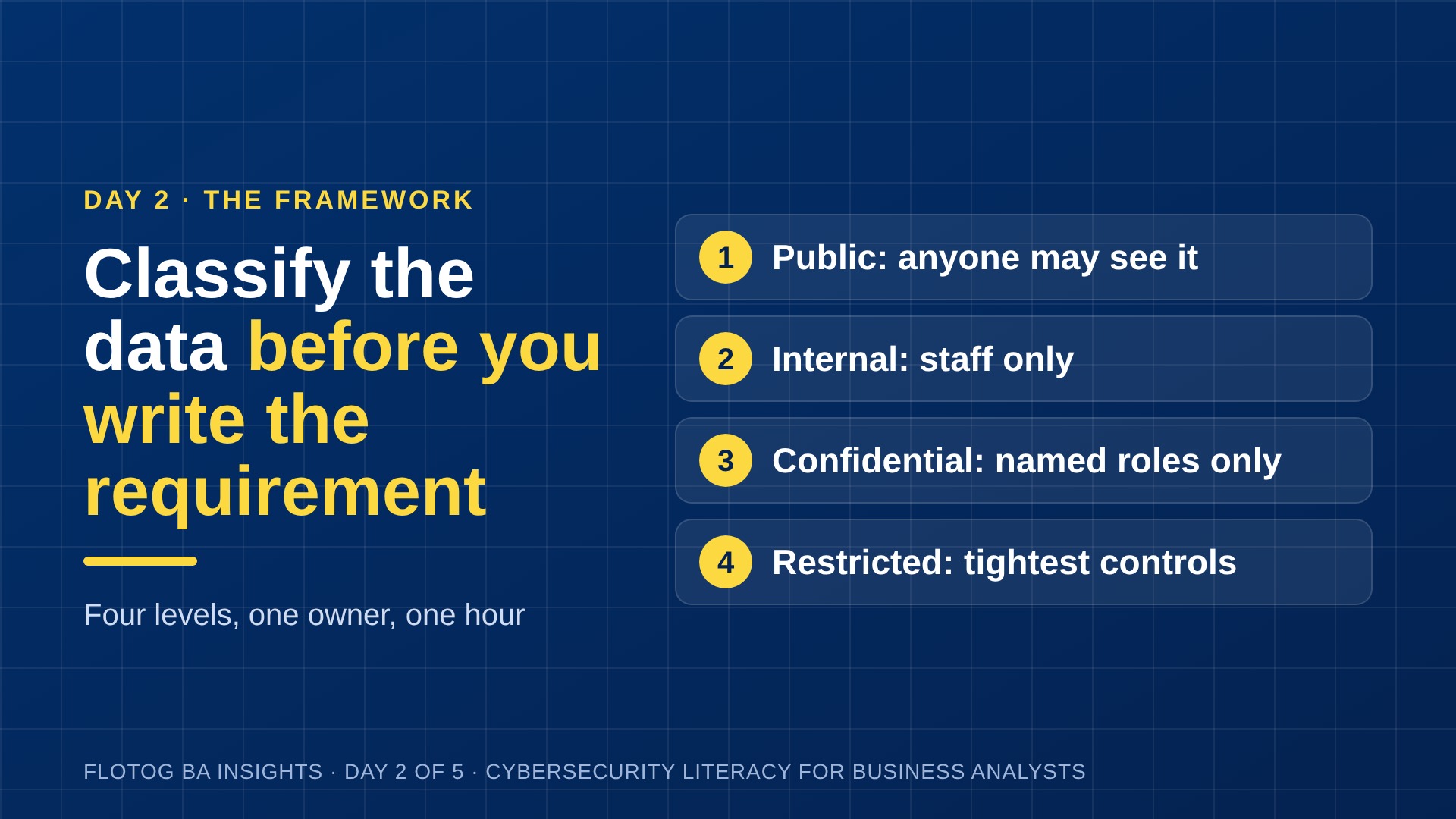
A system that treats every piece of data as top secret is slow, expensive and annoying to use. One that treats everything as ordinary is a breach waiting for a date. The way between the two is a short act of sorting that most projects skip, and it belongs to the business analyst: classify the data before you write the requirement. If you are joining us on day two, here is where we are. This week is five tools for business analysts who write requirements for systems that hold sensitive information. On day one we met the three ideas behind most security requirements, confidentiality, integrity and availability, and saw where security enters everyday analysis work. Today's tool is a way of deciding how much protection each kind of data needs, so that the requirements that follow are proportionate.
What classification is, and why analysts should lead it
Data classification means giving each kind of information a label that says how sensitive it is, and attaching rules to each label. The rules cover who may see the data, how it must be stored and sent, and how it is handled when it is shared or deleted. Most organisations of any size already have a scheme, usually in an information security policy. The first step is always to find it and use its names, because a requirement that uses the organisation's own words is far easier to get accepted.
Analysts are well placed to lead the exercise because they hold the list of data. Every requirements document, data dictionary or screen design names the fields a system will collect and show. A security team sees a system from the outside, while the analyst knows what is inside it, field by field. Sorting those fields into levels is a natural extension of work already being done.
One point of ownership matters. The level is decided by the person who owns the data in the business, not by the project team and not by IT. The owner understands what harm would follow if the data were exposed, altered or lost, and can say whether a customer list is merely internal or truly confidential. The analyst's job is to facilitate: propose a level, explain the reasoning and record the owner's decision.
Be clear about what classification is not. It is not a judgement about the people who use the data, and it is not a one-off label that never changes. A field can move up a level when it is combined with others, or down when it becomes public. Plan to review the levels when the system changes, and note in the requirements who is responsible for doing so.
A four-level scheme
Schemes vary, but four levels are common and enough for most projects. The table below shows one version with examples. Treat the names as illustrative and swap in your organisation's own wording.
A FOUR-LEVEL CLASSIFICATION SCHEME
| Level | What it means | Examples | Handling |
|---|---|---|---|
| Public | Approved for anyone to see. | Published marketing text, job adverts. | No special controls. |
| Internal | For staff. Low harm if it leaks. | Meeting notes, internal phone lists. | Staff access only. |
| Confidential | Real harm if shared outside the organisation. | Contracts, pricing, customer contact details, salaries. | Named roles only, with access recorded. |
| Restricted | Serious harm or a legal duty if exposed. | Identity numbers, payment card data, health records, passwords. | Tightest access, protected in storage and transfer. |
Illustrative scheme. Use the names and rules in your own organisation's policy.
Two rules make the scheme easier to apply. First, the highest level in a record sets the level for the whole record. A customer form that holds a name, an address and one identity number is a restricted record, because the strictest field decides how the whole thing must be handled. Second, personal data about people usually deserves extra care, and many countries have laws that govern it. The rules differ by market, so check what applies to your organisation. This series gives general guidance and is not legal advice.
Classification changes what you write next. A field marked restricted might be masked on screen except for the people who need it, left out of standard reports and blocked from bulk export. A field marked internal might need none of that. The same screen can therefore carry different requirements for different fields, and the classification column is what tells you which. Without it, teams tend to apply one rule to everything, and either the system becomes unusable or the sensitive fields are left exposed.
How to run the exercise in an hour
Start from the list of fields you already have. For each field or group of fields, propose a level, using the scheme in the table and the examples as a guide. It is quicker to propose and correct than to ask a room an open question, so come with a first draft. Take the draft to the data owner, talk through the fields where you are unsure, and record the decision. A simple extra column in the data dictionary, with the level beside each field, is enough.
Then follow the data. A classification is only useful if it travels with the information, so ask where each kind of data goes after it leaves the main system. Does it appear in reports? Is it exported to a spreadsheet? Is it emailed, printed, or sent to another system or an outside company? Each of those routes needs the same level of care as the original. Many real leaks come not from the system itself but from a copy that nobody remembered to include.
Sometimes a data owner will not engage, saying it is an IT matter or that everything is sensitive. Do not let that stall the work. Offer your draft as a starting point, explain in a sentence what each level means for the people who use the system, and ask only for corrections. If no owner can be found for a set of data, that is itself a finding, and it belongs on the risk list with the sponsor's name beside it.
Watch for two opposite mistakes. The first is labelling everything as confidential to be safe, which sounds careful but makes the controls so heavy that people work around them, often with a personal spreadsheet or a messaging app. The second is leaving data unclassified because nobody was sure, which leaves the project with no basis for any requirement. A reasonable draft, confirmed by the owner, is better than either. Tomorrow we take the levels and turn them into requirements that can be tested.
Go out and be successful.
Oluwatosin Ogunkoya · Flotog BA Insights · 1:1 mentoring and coaching for BAs at every career stage · www.flotogbainsights.com
TOMORROW
Writing Security Requirements That Can Be Tested - Turn "the system must be secure" into requirements that can be built, tested and accepted.