
Waterfall vs Agile: The hybrid model & what it actually means for BAs
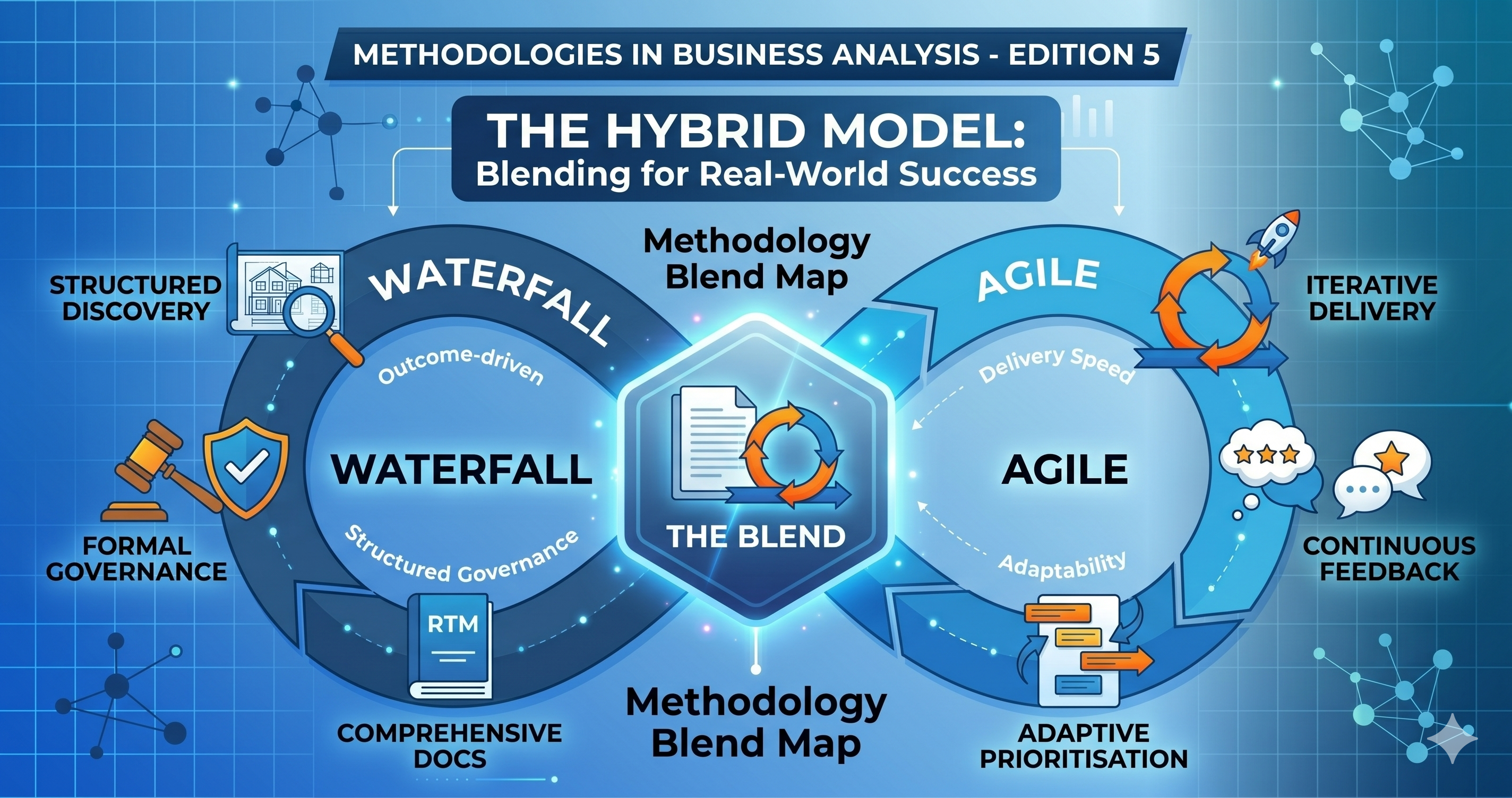
Fellow Business Analysts, we have spent three days examining Waterfall and Agile independently and in comparison. Today, we look at the space between them: the hybrid delivery model that most experienced practitioners quietly use on real projects, regardless of what the organisation officially calls its methodology.
Why Hybrid Is Not a Compromise; It Is the Answer
The word 'hybrid' sometimes carries a connotation of indecision as if being unable to commit to one methodology is a professional weakness. I want to challenge that framing directly.
A hybrid methodology is not the result of failing to choose. It is the result of analysing a project's specific characteristics and selecting the practices from each framework that best serve those characteristics. That is not indecision. It is the application of professional judgement which is precisely what distinguishes a senior BA from a practitioner who follows a process.
Consider what Waterfall does exceptionally well: structured discovery, comprehensive documentation, formal governance, phase-gate accountability, and disciplined handoffs. Consider what Agile does exceptionally well: iterative delivery, continuous stakeholder feedback, adaptive prioritisation, early value realisation, and rapid risk discovery. Now ask: is there any complex real-world project that would not benefit from some combination of these capabilities? The answer, in my experience, is no.
What Hybrid Actually Means and What It Does Not
It is worth being clear about what a hybrid methodology is, because the term is sometimes used to describe project environments that are neither Waterfall nor Agile but simply poorly organised.
A genuine hybrid is a deliberate architectural decision about which practices from each methodology to apply to which phases of delivery. It is not:
• Running sprints inside a project that was scoped and contracted using Waterfall assumptions, with no Agile governance mechanisms in place
• Producing a brief requirements document and calling it Agile because it is shorter than a BRD
• Adding retrospectives to a Waterfall project and declaring it hybrid
• Using whatever practices are convenient and labelling the result a methodology
A genuine hybrid has a coherent structure. The choice of which practices to apply in which phases is reasoned and documented. The team understands the logic behind the blend, not just the mechanics.
A Hybrid Structure That Works : The Three-Stage Model
Stage 1: Waterfall-Style Discovery and Foundation (Approximately Weeks 1-4)
Before any sprint begins, a structured discovery phase establishes the foundation that Agile delivery requires to function effectively. This phase applies Waterfall's strengths: thorough elicitation, formal stakeholder alignment, and comprehensive upfront documentation.
Key deliverables in this stage:
• Stakeholder map and engagement plan: identifying all parties with an interest in the outcome, their influence level, their communication preferences, and their decision-making authority
• Product Vision Document: a concise statement of the strategic objectives, the scope boundaries, the target users, and the definition of success. This is the north star that keeps the backlog coherent
• High-Level Requirements Framework: capturing the must-have requirements and non-negotiable constraints before delivery begins. This is not a full BRD, however, it is enough to structure the initial backlog intelligently
• As-Is Process Maps: documenting the current state to establish the baseline for improvement
• Risk and Dependency Register: identifying the risks that need to be managed across the delivery lifecycle and the dependencies that could constrain sprint sequencing
• Technical Architecture Review: ensuring that architectural decisions are understood before sprints begin, reducing the likelihood of late technical constraints disrupting delivery
Stage 2: Agile Delivery with Waterfall Governance Checkpoints
Delivery runs in sprint cycles: iterative, feedback-driven, and adaptive. The Agile practices that make delivery effective are fully in place: sprint planning, daily standups, sprint reviews, retrospectives, and continuous backlog refinement.
At defined intervals, typically every three or four sprints, the project passes through a formal governance checkpoint that applies Waterfall's accountability structures:
• Requirements traceability check: do the stories completed to date trace back to the strategic requirements captured in Stage 1?
• Product vision alignment review: is what is being built still aligned with the vision document? If the vision has evolved, the document should be updated and re-approved
• Risk and dependency review: have new risks emerged? Have dependencies been resolved or escalated?
• Formal stakeholder sign-off on completed increments: obtaining explicit approval for what has been delivered, creating an audit trail that protects both the delivery team and the business
This structure gives the project the responsiveness of Agile and the accountability of Waterfall simultaneously without the bureaucratic overhead of treating every sprint as a formal phase-gate.
Stage 3: Waterfall-Style Transition and Closure
When delivery is complete, the project transitions to business-as-usual using a structured approach that benefits from Waterfall's documentation discipline and formal handoff culture.
Key activities in this stage:
• Formal UAT sign-off: even in an Agile project that has had sprint reviews throughout, a formal UAT period provides a final integration test and a documented business acceptance
• Comprehensive training and support documentation: consolidated from sprint artefacts into a coherent reference set
• Cutover and go-live planning: the detailed sequencing of deployment activities, data migration, parallel-run arrangements, and rollback procedures
• Post-deployment support plan: defining how defects will be triaged, how enhancements will be requested, and how the system will be maintained
The BA's Toolkit in a Hybrid Environment
The hybrid BA draws selectively from both methodology toolkits, applying each practice where it adds the most value:
From Waterfall
• Business Requirements Document: for strategic-level requirements that define the scope and objectives of the whole programme
• Requirements Traceability Matrix: for maintaining the thread between sprint stories and strategic requirements
• Process Maps: for documenting current and future state at the level of business operations
• Formal Change Control: for scope changes above an agreed threshold that would affect the product vision or the governance baseline
From Agile
• User Stories: for sprint-level requirements that translate strategic needs into buildable, testable units
• Acceptance Criteria: for defining observable, verifiable completion conditions for each story
• Backlog Management: for maintaining a prioritised, sprint-ready queue of work
• Sprint Ceremonies: for continuous stakeholder engagement, team communication, and adaptive planning
Hybrid-Specific
• Sprint-level RTM: linking each story to its parent requirement in the strategic requirements framework
• Rolling Requirements Horizon: detailed for the next two sprints, high-level beyond that, reviewed and refined continuously
• Business Readiness Tracker: updated each sprint to track the organisation's preparedness to adopt each completed increment
Three Signs Your Organisation Needs a Hybrid Approach
Your Agile Project Has No Documented Product Vision
If different stakeholders interpret the project's scope differently and there is no agreed document to arbitrate, your backlog will be incoherent and your sprints will pull in different directions. The discovery discipline of Waterfall is needed before Agile delivery can function effectively.
Your Waterfall Project's Change Request Log Is Overloaded
If your formal change control process is struggling to keep pace with the volume of legitimate requirement changes, and your baseline is effectively a fiction, you need the adaptive backlog management of Agile to absorb change without constant formal reworking of the requirements baseline.
You Need Both Formal Governance and Delivery Speed
Many organisations operate in environments that require formal audit trails and documented governance while also needing to deliver quickly and respond to changing business conditions. This is not a contradiction. A hybrid model, Agile delivery inside Waterfall governance checkpoints, is the designed solution for exactly this tension.
Go out and be successful.
— Oluwatosin Ogunkoya
Tomorrow: Series Finale - Interview Masterclass and career application. Six real interview questions with model answers at every BA level, plus the recap that ties this whole week together.