
Waterfall vs Agile: The Honest Comparison
Eight real dimensions. No tribalism. Just analysis
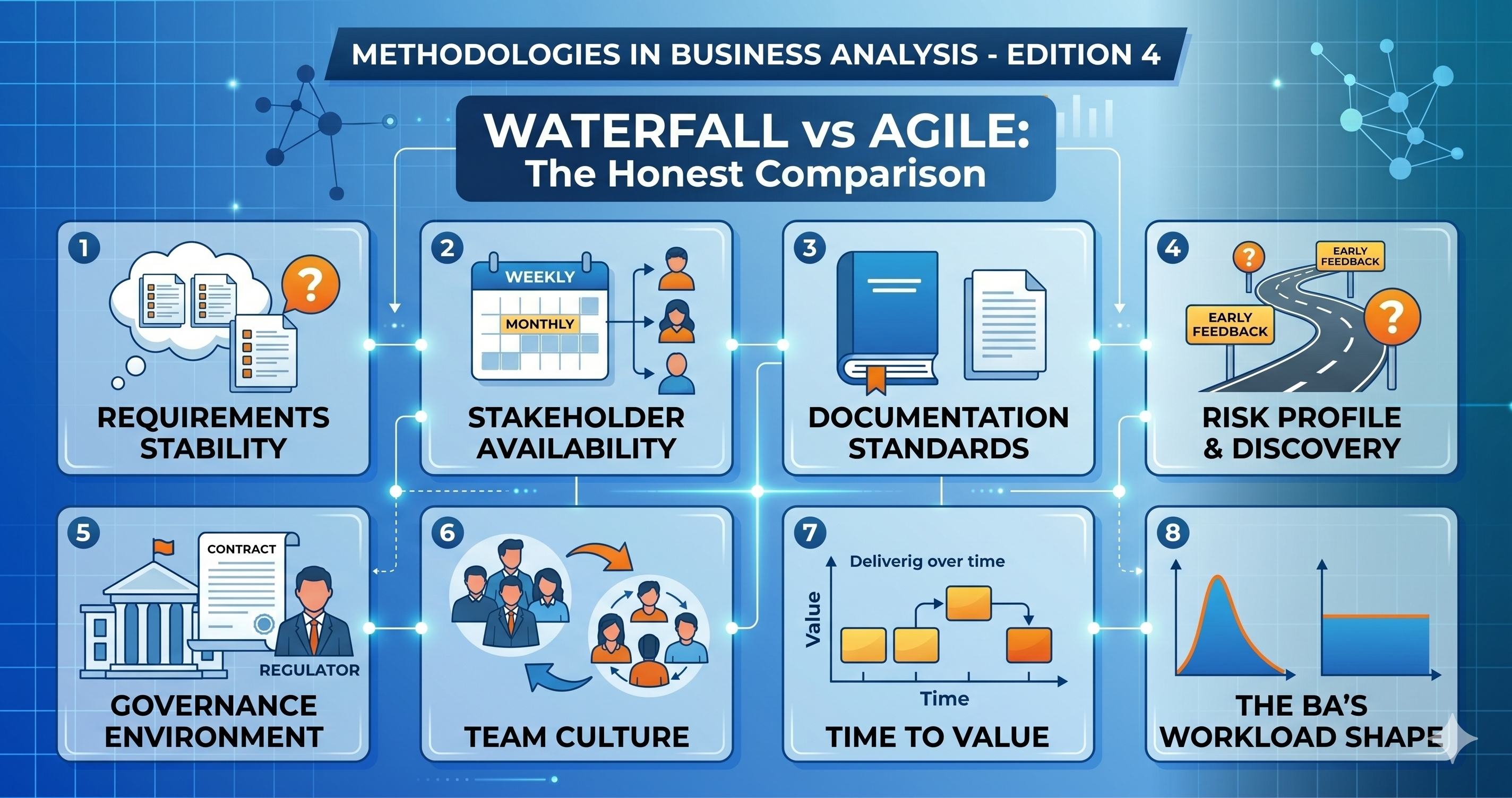
Over the past two days, we have examined Waterfall and Agile on their own terms, their phases, their BA deliverables, their strengths, their failure points, and the real-world scenarios where each one earns its place. Today, we put them side by side.
But I want to do this differently from the standard methodology comparison tables you will find in textbooks or certification study guides. Those comparisons typically contrast theoretical ideals in ideal conditions. What I want to contrast are honest realities, the dimensions that actually determine whether a methodology will serve your project well.
The Comparison Most People Get Wrong
Before the framework, a critical observation: the methodology debate is consistently distorted by a framing error that affects practitioners on both sides.
Agile advocates compare the best possible Agile implementation: responsive, collaborative, iterative, value-driven, against a caricature of Waterfall: a slow, bureaucratic, change-resistant process that delivers the wrong thing eighteen months late. Waterfall advocates compare the best possible Waterfall implementation: rigorous, documented, predictable, audit-ready, against a caricature of Agile: chaotic, under-documented, scope-unstable, and lacking in the discipline needed for serious delivery.
Neither comparison is analytically honest. A poorly run Agile project with weak BA involvement and an undisciplined backlog is not a success story. A well-run Waterfall project with experienced BAs, thorough elicitation, and strong stakeholder alignment is not a failure waiting to happen.
The methodology does not determine the outcome. The quality of practice does.
Eight Dimensions That Matter to Business Analysts
1. Requirements Stability
Waterfall is optimised for environments where requirements can be fully defined before development begins. Its phase-gate structure assumes that what is documented in Phase 1 is essentially what will be built, and that changes to that baseline will be the exception, managed through formal change control.
Agile is designed for environments where requirements are expected to evolve. Its iterative structure is built on the premise that users do not fully know what they need until they see something working, and that the most valuable requirements information is gathered from interaction with working software, not from workshop elicitation.
The practical question for the BA is not 'which is better' but 'how stable are the requirements likely to be on this specific project, and which methodology better serves that reality?'
2. Stakeholder Availability and Engagement Model
Agile's feedback-loop model requires sustained, regular stakeholder engagement throughout delivery. Sprint reviews, backlog refinement sessions, story clarifications during sprints, and acceptance decisions all require stakeholders who are available, engaged, and empowered to make decisions.
In many organisations, this level of business engagement is aspirational rather than actual. Senior stakeholders have competing priorities. Business subject matter experts cannot always attend sprint ceremonies. When Agile is implemented without the stakeholder engagement model it requires, the feedback loop, which is Agile's primary mechanism for quality, breaks down.
Waterfall's concentrated stakeholder engagement model, intensive at the requirements phase and formal at review gates, can be more manageable for stakeholder groups with limited availability.
3. Documentation Standards
Waterfall produces a comprehensive documentation suite: BRD, functional specifications, design documents, test plans, UAT results, deployment guides, and training materials. This documentation serves governance, auditing, knowledge transfer, and system maintenance purposes that extend well beyond the project lifecycle.
Agile produces lighter documentation focused on what serves delivery: user stories, acceptance criteria, definition of done, sprint goals, and retrospective outputs. The emphasis is on documentation that is current and actionable, rather than comprehensive and archival.
In regulated industries, government programmes, and environments with formal audit requirements, Waterfall's documentation weight is an asset. In commercial product development and internal transformation programmes, overhead often slows delivery without proportionate benefit.
4. Risk Profile and Discovery Timing
In Waterfall, the primary risk is late discovery of misalignment. If requirements were poorly elicited, if stakeholders change their minds, or if the business context shifts mid-project, the consequences are felt in testing or, worse, in post-deployment. The cost of fixing a requirements error in UAT is estimated to be 10 times that of fixing it during elicitation.
In Agile, risks are distributed across the sprint cycle. Because working software is demonstrated to stakeholders every sprint, misalignment is discovered early and corrected cheaply. The risk model is one of many small course corrections rather than one large final reckoning.
For projects where a late fundamental misalignment would be commercially, operationally, or contractually catastrophic, Agile's early and frequent discovery mechanism is a significant structural advantage. For projects where the requirements are well-defined and stable, the additional overhead of Agile's sprint infrastructure may not be warranted.
5. Regulatory and Governance Environment
Waterfall's formal phase-gate governance, documented sign-off culture, and comprehensive audit trail are aligned with how regulated industries, government procurement frameworks, and formal contractual arrangements actually operate. Regulators want evidence. Auditors want documentation. Waterfall delivers both.
Agile's adaptive scope management, where requirements evolve sprint by sprint, creates tension in these environments. Contractual commitments made against a fixed scope may be undermined by a backlog that changes weekly. Regulatory frameworks that require documented requirements before development begins may not accommodate a user story model.
6. Team Culture and Organisational Maturity
Agile's effectiveness is highly sensitive to team culture and organisational conditions. Self-organising teams require psychological safety and trust. Direct business-technology collaboration requires that organisational silos have been at least partially dismantled. Empowered Product Ownership requires that the business has designated someone with genuine authority to make prioritisation decisions.
In organisations that lack these conditions, Agile ceremonies become a performance. Standups happen, but problems are not raised. Sprint reviews are attended, but feedback is not acted upon. Backlogs are maintained, but priorities are not genuinely set. The framework is in place; the culture it requires is not.
7. Time to Value
Agile delivers value progressively. Users can begin using working functionality from the first sprint, while subsequent sprints continue to build the product. This changes the commercial and operational relationship with delivery value is not deferred until the end of a lengthy project.
Waterfall delivers the complete product at the end of the project lifecycle. For complex, interdependent systems where no individual component has a standalone value, this is not a disadvantage; partial delivery is not useful. For products where incremental capability has genuine value, the Waterfall model defers value unnecessarily.
8. The BA's Workload Shape
In Waterfall, the BA's workload is front-loaded and intensive, then reduces through the delivery phases. The requirements phase demands the most from the BA; subsequent phases demand active support rather than leadership.
In Agile, the BA's workload is continuous and constant throughout the entire delivery. There is no 'lighter' period. The backlog always needs to be two sprints ahead. Stakeholder relationships always need to be maintained. Sprint ceremonies always need the BA to be present, prepared, and engaged.
A Practical Decision Framework
When you face a methodology decision on a new project or programme, these four questions will cut through the noise:
• How stable and complete are the requirements likely to be before development begins? If high stability: lean Waterfall. If expected to evolve: lean Agile.
• What does the regulatory, contractual, or governance environment require? If formal documentation and sign-off are required, a waterfall structure is necessary regardless of other factors.
• How available and engaged can business stakeholders be throughout delivery? If sustained availability is possible, Agile's feedback model will work. If concentrated availability is more realistic, Waterfall's front-loaded model may serve better.
• What is the cost of late discovery? If a fundamental misalignment discovered late would be catastrophic: Agile's early feedback loops reduce this risk. If requirements are well-defined enough to be confident, Waterfall's sequential model is efficient.
In practice, the answer for most complex projects sits in the space between the two methodologies, which is exactly where tomorrow's content begins.
Go out and be successful.
Oluwatosin Ogunkoya
Tomorrow: The Hybrid Model - a full deep-dive into what blending actually means, how to structure it, and what the BA's toolkit looks like in a hybrid delivery environment.