
Day 3 · Process Improvement Mastery: How Business Analysts Lead Change, Not Just Document It
Lean Thinking and Kaizen: The BA's Guide to Continuous Improvement
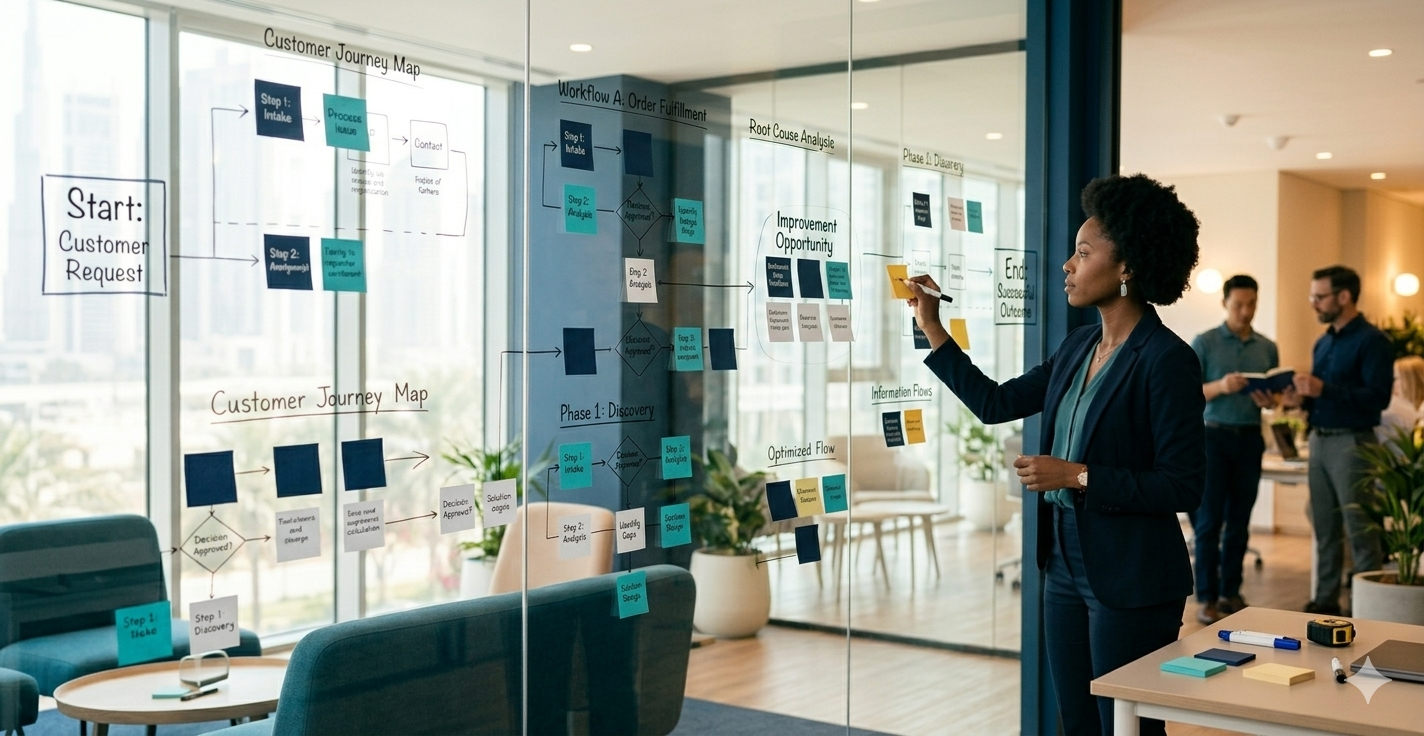
Lean thinking originated in manufacturing. It was developed at Toyota in the decades following World War Two, as a response to the challenge of producing high-quality vehicles with limited resources in a recovering economy. The Toyota Production System, from which Lean thinking is drawn, was built on a single obsession: eliminating everything in a production process that did not directly contribute to creating value for the customer. Over the following decades, Lean principles moved from manufacturing floors into service operations, healthcare, logistics, software development, and eventually into business analysis practice. The specific context changed. The core principle stayed the same. Value is what the customer is willing to pay for. Everything else is waste. Find the waste and remove it. For a Business Analyst, Lean thinking is not a methodology to follow. It is a lens to look through. And once you learn to look through it, you will never review a process the same way again.
The Eight Types of Waste
Lean practice identifies eight categories of waste, often remembered with the acronym DOWNTIME. Each one represents a category of activity or condition in a process that consumes resources without producing value. Learning to recognise these in a process review is one of the most practical skills a BA can develop.
- Defects: Defects are errors in output that require rework, correction, or disposal. In a business process context, defects include data entry errors that require correction, reports produced with incorrect figures, orders processed with missing information, and any output that does not meet the standard required by the next step in the process. Defects are expensive because they are discovered after the work has already been done. The resource invested in producing the defective output is wasted. Additional resources are then invested in finding and correcting the error. In many organisations, a significant proportion of total process capacity is consumed by fixing mistakes rather than producing good work the first time.
- Overproduction: Overproduction is producing more than is needed, earlier than it is needed, or faster than the next step in the process can use. In manufacturing, it means making products that sit in inventory. In a business process, it means producing reports nobody reads, generating approvals that are never acted on, and creating documentation that serves no current purpose. Overproduction is often a signal of poor communication between process steps. One part of the process produces output because it can, not because the next step is ready for it.
- Waiting: Waiting is idle time created when a step in the process cannot proceed because it is waiting for something from a previous step. Waiting for an approval. Waiting for data to be transferred. Waiting for a meeting to be scheduled. Waiting for a system to complete a batch process. Waiting is one of the easiest wastes to identify in a process review because it shows up in the time between process steps. When a process map shows activities and handoffs, the time between handoffs is where waiting lives. In many processes, the total calendar time from start to finish is ten or twenty times the actual processing time because of accumulated waiting at each handoff.
- Non-Utilised Talent: Non-utilised talent is the waste of human capability. People doing work below their skill level. Experts performing tasks that could be automated or handled by a less experienced resource. Knowledge and ideas that are not sought or used. This is the waste most directly relevant to organisations investing in technology improvement. When a system implementation removes manual processing steps, the people who were performing those steps have capacity that needs to be redirected. Organisations that implement systems without thinking about what their people will do with the freed time often find that the capacity savings are absorbed by other forms of waste rather than converted into value.
- Transportation: Transportation waste is the unnecessary movement of materials, information, or documents between process steps. In a business process context, this includes sending documents between departments for sequential approvals that could be handled in parallel, routing information through intermediaries who add no value to it, and moving data between systems through manual re-entry rather than integration.
- Inventory: Inventory waste is the accumulation of work in progress, information, or materials that is sitting waiting to be processed. In a business context, it includes queues of emails awaiting response, cases awaiting allocation, requests awaiting approval, and data awaiting processing. Inventory indicates a mismatch between the rate at which work arrives and the capacity available to process it.
- Motion: Motion waste is unnecessary movement by people within a process. In a service or office environment, motion waste includes navigating multiple systems to complete a single task, switching between applications to find information that should be accessible in one place, and performing manual steps that a system could automate.
- Extra Processing: Extra processing is doing more to a product or piece of work than the customer requires or the next step in the process needs. Producing detailed reports when a summary would serve the purpose. Running validation checks that duplicate checks performed by a system. Obtaining approvals at multiple levels for decisions that are routine and low-risk. Extra processing is often the hardest waste to challenge because it is frequently defended with references to quality, compliance, or risk management. Some of it genuinely is necessary. A significant proportion of it is historical habit that was never reviewed.
Kaizen: Continuous Improvement as a Practice
Kaizen is a Japanese concept that translates roughly as change for the better. In business practice, it refers to the philosophy of continuous, incremental improvement rather than occasional large-scale transformation. The Kaizen approach to improvement is built on a specific belief: that the people closest to a process are the best source of ideas for improving it, and that small improvements made consistently over time produce better outcomes than large improvement projects undertaken periodically. For a Business Analyst, Kaizen thinking changes how you engage with stakeholders during process reviews. Instead of approaching the review as a project, with a start, a middle and a defined end, you approach it as the beginning of an ongoing practice. The process map you produce is not the output. It is the starting point for a conversation about what could be better.
In practical terms, this means building improvement identification into your process documentation work. When you document a step, ask the person performing it whether there is anything about it that slows them down, creates errors, or feels unnecessary. Capture those observations alongside the process documentation. Many of the best improvement ideas will come from that question, and they will come from people who have been waiting for someone to ask it.
Value Stream Mapping in BA Practice
Value Stream Mapping, often called VSM, is a Lean technique for visualising the full flow of a process from the point where value creation begins to the point where it is delivered to the customer. Unlike a standard process map, which shows what happens, a Value Stream Map shows what happens and how long each step takes, how long the waiting between steps takes, and what the ratio of value-adding time to total elapsed time is. That ratio is revealing. In most processes, the actual time spent doing work that directly creates value is a small fraction of the total time the process takes. The rest is waiting, rework, transportation, and other forms of waste. Making this visible is what motivates improvement.
A BA running a Value Stream Mapping exercise works through the process in two stages. The first stage produces the current state map, showing the process as it actually is, with real-time data for each step and each waiting period. The second stage produces the future state map, showing what the process could look like if identified waste were removed, with the projected time and quality improvements that would result. The gap between the current state and the future state is the improvement opportunity. The future state map becomes the target, and the work of getting from current state to future state is the improvement initiative.
You do not need specialist software to run a Value Stream Mapping exercise in BA practice. A whiteboard, sticky notes, and the right stakeholders in the room are sufficient for most business process improvement work. What you do need is accurate time data for each step, which means either observing the process directly or working closely with the people who run it to capture realistic rather than theoretical timings.
Applying Lean Without Becoming a Process Engineer
A concern I hear from BAs when Lean thinking comes up is that it feels like a different discipline. Something that requires specialist training or certification before it can be applied.
It does not. The Lean tools that are most valuable in BA practice - the eight wastes framework, Kaizen thinking, and Value Stream Mapping - do not require certification to use effectively. What they require is curiosity about why processes work as they do, the willingness to ask questions that challenge the status quo, and the analytical discipline to move from observation to evidence before designing a solution. Those are BA skills. Lean thinking gives them a framework. The combination produces a practitioner who not only documents processes but also genuinely improves them.
Go out and be successful.
Oluwatosin Ogunkoya | Flotog BA Insights | www.flotogbainsights.com
Tomorrow: Leading an Improvement Initiative. How to structure the work, bring stakeholders with you, manage resistance, and measure whether the change actually delivered what you promised.