
Interview masterclass: how to answer methodology questions - Waterfall Vs Agile
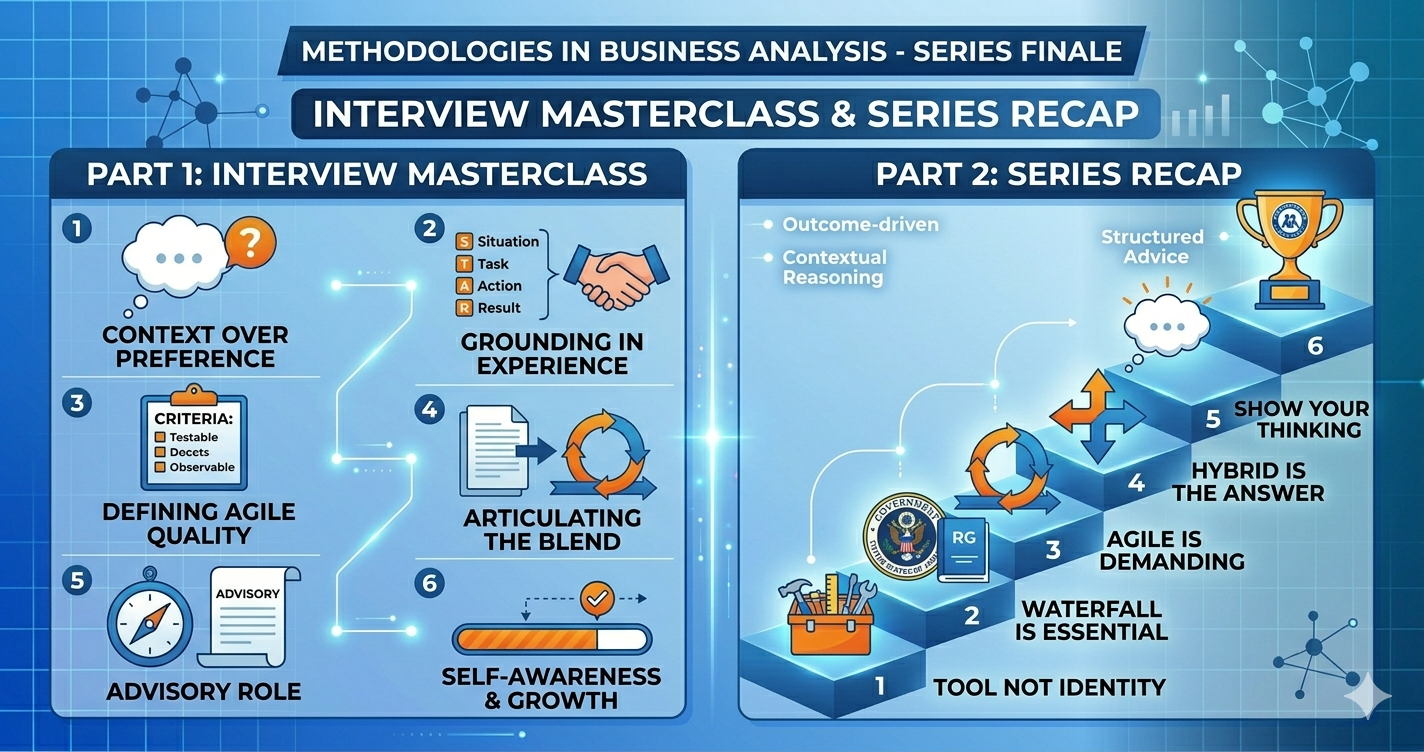
Fellow Business Analysts, we have reached the final edition of this week's series. Over five days, we have built something that I hope is genuinely useful, not just a survey of two methodologies, but a framework for thinking about delivery that you can apply to your next project, in your next interview, and in your next stakeholder conversation.
Today's edition has two parts: an interview masterclass covering six real methodology questions with model answers at every BA level, and a series recap that distils the week's most important principles into a form you can carry forward and use.
What Interviewers Are Actually Testing
Before the questions and answers, it is worth understanding the assessment framework that interviewers use when they ask methodology questions, because understanding what they are looking for changes how you construct your answers.
Methodology questions at BA interviews are rarely about the methodology itself. There are about three competencies that methodology questions happen to surface very effectively:
Analytical Thinking
Can you evaluate a framework based on contextual factors and project-specific characteristics, rather than defaulting to what you are most familiar with? Do you understand the trade-offs between different approaches, or do you see methodology as binary?
Real-World Experience
Can you ground your answers in specific examples from projects you have actually worked on? Can you describe the methodology's practical impact on your BA practice, the specific deliverables you produced, the challenges you faced, and the way you adapted your approach?
Self-Awareness and Intellectual Honesty
Do you have a realistic understanding of your own methodology strengths and gaps? Are you willing to acknowledge where your experience is limited and articulate what you are doing about it? Interviewers at the senior level value intellectual honesty significantly more than they value projected confidence without substance.
Six Real Interview Questions & Model Answers at Every Level
Question 1: Do you prefer Waterfall or Agile?
Level: Junior to Mid BA
What the interviewer is testing: whether you can demonstrate contextual thinking rather than tribal preference.
Model Answer: 'I do not have a strong preference for one over the other. I think the right question is which methodology best serves the project at hand. In my experience, Waterfall works well when requirements are stable and well-understood, and when the environment requires formal documentation and governance structures. Agile works well when requirements are expected to evolve, and stakeholders can be closely involved throughout delivery. On my most recent project, we used [methodology] because [specific contextual reason], for example, we were in a regulatory environment that required formal phase-gate sign-off, or we were building a digital product where early user feedback was critical. The practice I found most valuable was [specific practice], because it [specific benefit it delivered].'
Why this works: it demonstrates contextual thinking, grounds the answer in real experience, and avoids signalling methodology tribalism.
Question 2: Tell me about a time requirements changed significantly mid-project, and how you handled it?
Level: Mid BA
What the interviewer is testing: your change management competence, your analytical response under pressure, and your ability to protect the project without antagonising stakeholders.
Model STAR Answer:
• Situation: On a system integration project in [sector], we were three months into development when a regulatory change significantly altered the compliance requirements for our core reporting module. We had a baselined BRD and a development team already building against it.
• Task: I needed to assess the full impact of the regulatory change, manage the stakeholder communication, and guide the project through the appropriate change management process without losing momentum.
• Action: I produced a formal impact assessment within forty-eight hours, covering scope, timeline, budget, and risk. I convened an emergency stakeholder review with the project sponsor, the technical lead, and the compliance team. We used the formal change control board to review and approve the re-baselined requirements. I updated the RTM to reflect the changed scope and worked with the test manager to reprioritise the UAT schedule.
• Result: We absorbed the regulatory change with a three-week schedule extension that was formally approved by the sponsor. The project delivered against the revised baseline on time and passed the regulatory audit without findings related to the change management process.
Question 3: How do you ensure the quality of requirements in an Agile environment?
Level: Mid BA
What the interviewer is testing: your Agile BA practice depth, specifically, whether you have a systematic approach to backlog quality rather than a reactive one.
Model Answer: 'I treat backlog quality as my primary BA accountability in Agile, and I use several specific practices to maintain it. First, I maintain a two-sprint readiness buffer; the top of the backlog is always at least two sprints ahead in terms of story refinement and acceptance criteria completeness. This means sprint planning is never delayed by stories that are not ready. Second, I write acceptance criteria in an observable, verifiable format; every criterion must be testable against the live system without subjective interpretation. I use a standard pattern: Given [context], When [action], Then [outcome]. Third, I run a structured backlog review with the Product Owner before every sprint planning session to ensure that priority logic reflects the current business context, not assumptions made two weeks ago. Finally, I treat every sprint review as an elicitation session; the feedback stakeholders give on working software is the highest-quality requirements input available in Agile, and I have a structured approach to capturing it and converting it into backlog items.'
Question 4: What is your experience of working in a hybrid methodology environment?
Level: Senior BA
What the interviewer is testing: whether you have genuinely operated in complex delivery environments that require more than one methodology, and whether you can articulate a structured approach to blending.
Model Answer: 'Most of my senior project experience has been in environments where a pure Waterfall or pure Agile approach was not the right solution, either because the governance requirements of the organisation did not allow fully adaptive scope management, or because the complexity of the requirements landscape needed more upfront structure than a pure Agile model provides. My default approach is a three-stage hybrid: I apply Waterfall-style discovery at the outset to establish the product vision, the strategic requirements framework, and the stakeholder governance structure. Delivery then runs in Agile sprints with formal review checkpoints every three to four sprints for requirements traceability and sponsor sign-off. Finally, I use a Waterfall-style transition phase for formal UAT, training documentation, and go-live management. I maintain both a strategic BRD at the programme level and a user story backlog at the sprint level, with RTM traceability connecting the two. This gives stakeholders the governance accountability they need while preserving the team's ability to adapt.'
Question 5: How would you advise a project sponsor on methodology selection for a new programme?
Level: Senior BA
What the interviewer is testing: your advisory capability; can you take a sponsor through a structured decision-making process rather than simply recommending your preferred methodology?
Model Answer: 'I would begin by walking the sponsor through four diagnostic questions, because the right methodology choice depends entirely on the specific characteristics of the programme:
• How stable and complete are the requirements likely to be before development begins? If the business can fully define its needs upfront, a Waterfall structure is appropriate. If requirements will evolve as users see working software, Agile's iterative model will produce better outcomes.
• What does the regulatory, contractual, or governance environment require? If formal documentation, phase-gate sign-off, or contractual scope commitments are needed, the methodology must accommodate those requirements regardless of other factors.
• How available and engaged can business stakeholders be throughout delivery? Agile requires sustained stakeholder engagement. If that is not realistic, a front-loaded Waterfall model may be more appropriate.
• What is the cost of late discovery? If discovering a fundamental misalignment late in the project would be commercially or operationally catastrophic, Agile's early feedback loops significantly reduce that risk.
Based on the answers, I would present a structured recommendation. Waterfall, Agile, or hybrid, with explicit reasoning tied to the programme's specific characteristics, and documented in a decision paper that the sponsor can use for governance purposes.'
Question 6: What is your biggest gap in methodology experience, and what are you doing about it?
Level: All levels
What the interviewer is testing: your self-awareness, your intellectual honesty, and the quality of your professional development approach. This question trips up practitioners who try to disguise a weakness as a strength.
Model Answer: 'I have spent the majority of my career in [Agile/Waterfall] environments, which means my deepest experience and my greatest competence is in that context. My gap is in [the other methodology], specifically in [a concrete area: e.g. managing formal change control in a high-volume change environment / facilitating backlog refinement at scale across multiple product streams / writing acceptance criteria that hold up in complex technical testing environments]. I am addressing this actively: [specific action, for example: I have sought out the opportunity to shadow a senior BA on a Waterfall government programme / I have been leading backlog refinement for a new product stream to build my Agile practice depth / I am currently working through [specific course or certification]]. I believe that a BA who can operate confidently in both methodology environments is significantly more valuable and more employable than one who is optimised for only one, and developing that bilingual capability is a deliberate part of my professional development at this stage.'
Series Recap: The Six Principles to Carry Forward
This week has covered significant ground. Before we close, here are the six principles that sit at the heart of everything we have explored; the ones I want you to keep with you long after this series has scrolled off your feed.
1. Methodology is a tool, not an identity
The moment you declare loyalty to a methodology, you have limited your analytical thinking. Your job is to select and apply the right tool for each specific project context, and that requires genuine competence in more than one framework.
2. Waterfall is not outdated
It is essential in regulated industries, fixed-scope environments, complex system integrations, and anywhere that formal governance and documented accountability are not preferences but requirements. Dismissing Waterfall is not a sign of sophisticated thinking. It is a sign of limited experience.
3. Agile is not easier
Agile is differently demanding. The BA who treats it as permission to skip structured analysis, reduce documentation quality, or disengage from stakeholder management is not practising Agile. They are practising an absence of BA practice with a sprint cadence as cover.
4. The hybrid model is the professional answer for most complex projects
A deliberate, structured blend of Waterfall and Agile practices, applied based on what each phase of the project needs, is not a compromise. It is the output of professional judgement. Most experienced practitioners arrive at it eventually. The goal is to arrive at it deliberately rather than by accident.
5. In interviews, show your thinking, not your preference
Contextual reasoning, grounded in specific examples, is what distinguishes a senior BA answer from a junior one in a methodology discussion. The interviewer wants to see how you think, not which team you support.
6. The best BAs belong to the outcome, not the methodology
This is the principle that all five others serve. Your role as a Business Analyst is to help your organisation achieve its objectives. The methodology you use is in service of that goal, not the other way around.
Thank you for spending this week with me. This series has been one of the most comprehensive I have produced, and I hope it serves you well in your next interview, your next project, and your ongoing professional development.
Go out and be successful.